

5G technology has become common in Lithuania, and the choice among 5G routers is extensive. This article discusses key models such as Teltonika RUTX50, RUTC50, RUT241, and TP-Link Archer NX200. Each offers specific advantages depending on needs—from industrial solutions to home networks.
Key Facts:
- Teltonika RUTX50: Industrial 5G device with dual SIM card support, designed for stability in extreme conditions (price from €480 ex. VAT).
- Teltonika RUTC50: Modern 5G model with Wi-Fi 6 and eSIM, suitable for complex tasks (price around €615 ex. VAT).
- Teltonika RUT241: Compact 4G LTE solution for backup connectivity or IoT projects (price around €157 ex. VAT).
- TP-Link Archer NX200: Choice for home and small offices with Wi-Fi 6 and 5G speeds up to 4.67 Gbps (price around €227 ex. VAT).
Quick Comparison Table:
| Model | 5G Speed | Wi-Fi Standard | SIM Slots | Price (ex. VAT) |
|---|---|---|---|---|
| Teltonika RUTX50 | Up to 3.4 Gbps | Wi-Fi 5 | 2 x SIM | €480 |
| Teltonika RUTC50 | Up to 3.4 Gbps | Wi-Fi 6 | 2 x SIM + eSIM | €615 |
| Teltonika RUT241 | - (4G LTE) | Wi-Fi 4 | 1 x SIM | €157 |
| TP-Link Archer NX200 | Up to 4.67 Gbps | Wi-Fi 6 | 1 x Nano SIM | €227 |
The choice depends on your needs: for industry, Teltonika models are recommended, while for home use, the TP-Link Archer NX200 is suitable. Further in the article, we will discuss the features and applications of each device.
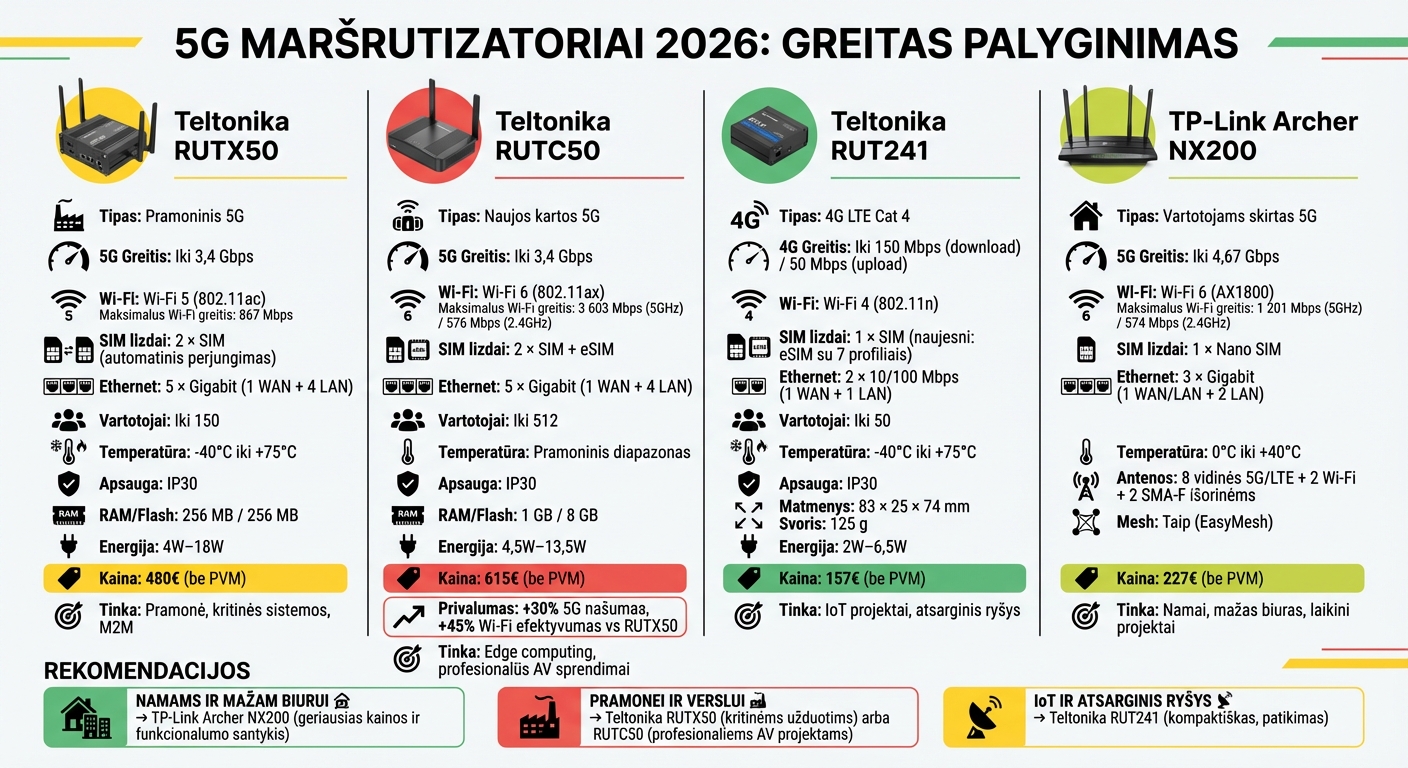
5G Router Comparison 2026: Teltonika RUTX50, RUTC50, RUT241, and TP-Link Archer NX200
RUTC50 5G Wi-Fi 6 Router: Your Ultimate Wireless Multitool | Webinar
sbb-itb-02aace5
1. Teltonika RUTX50
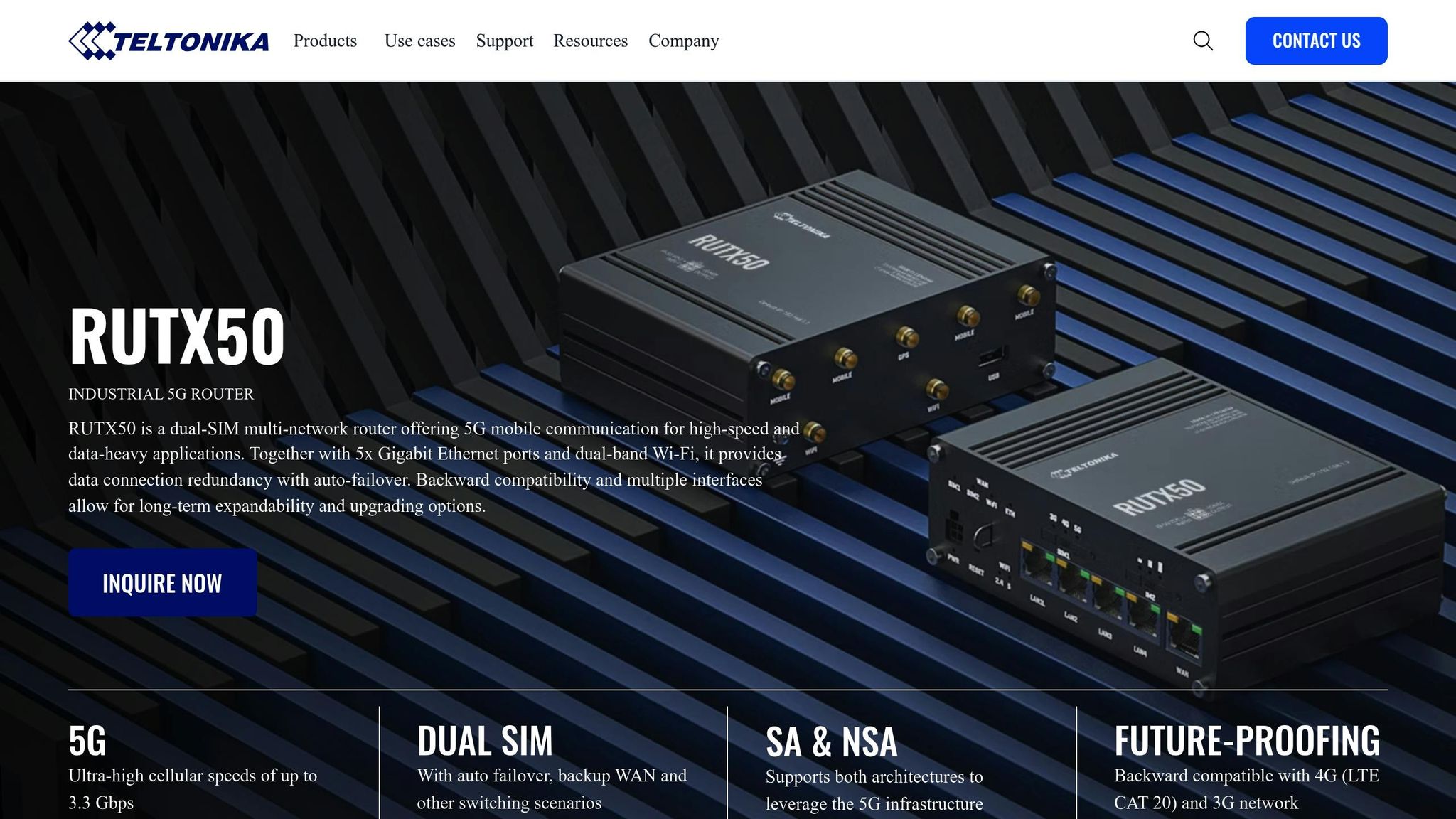
Teltonika RUTX50 is a 5G industrial router designed to ensure ultra-low latency and high connection speed. It supports 3.3 Gbps download and 900 Mbps upload speeds on 5G Sub-6GHz networks, and using 4G (LTE Cat 20) technology, it achieves speeds up to 2.0 Gbps [2][5].
The device has five Gigabit Ethernet ports (1 WAN and 4 LAN) with 10/100/1000 Mbps speed. Additionally, it offers Wi-Fi 5 (802.11ac) dual-band wireless connectivity with MU-MIMO technology, allowing speeds up to 867 Mbps and serving up to 150 users simultaneously [2][5]. Dual SIM card slots with automatic failover ensure uninterrupted connectivity, which is especially important for critical systems.
The RUTX50 features an industrial design – an aluminum casing with IP30 protection ensures durability, and an operating temperature range from -40 °C to 75 °C allows the device to be used in extreme conditions. The quad-core ARM Cortex A7 processor (717 MHz), along with 256 MB RAM and 256 MB Flash memory, ensures stable operation [2][5].
The device uses RutOS, a Linux-based operating system, which offers advanced security features, VPN capabilities (OpenVPN, IPsec, WireGuard), and supports industrial protocols such as Modbus, MQTT, and DNP3 [2][5]. Power consumption ranges from less than 4 W at idle to 18 W at maximum load [2][5].
In Lithuania, prices for this router start from €480.00 (ex. VAT) and go up to €499.98 (inc. VAT) [4][5]. Due to its reliability and stability, it is perfectly suited for professional audio-visual solutions, industrial automation, and M2M applications where high throughput and reliable connectivity are required. Next, we will discuss the capabilities of another Teltonika model.
2. Teltonika RUTC50
Teltonika RUTC50 is a new-generation 5G router that offers fast connectivity and modern Wi-Fi 6 capabilities. It supports 5G Sub-6 GHz networks, providing download speeds of up to 3.4 Gbps and upload speeds of 900 Mbps[6][8]. Compared to the RUTX50 model, this device boasts 30% higher 5G performance and 45% more efficient Wi-Fi operation[10].
In addition to impressive 5G connectivity, the RUTC50 also stands out with advanced wireless capabilities. The main highlight is Wi-Fi 6 (802.11ax) with MU-MIMO technology, which allows up to 512 users to be served simultaneously[7][8]. Wireless speeds reach 3,603 Mbps on the 5 GHz band and 576 Mbps on the 2.4 GHz band[3]. Furthermore, the device has five Gigabit Ethernet ports (1 WAN and 4 LAN) and a USB-A 2.0 port[8].
Technical specifications are also impressive: a dual-core ARM Cortex-A53 processor (1.3 GHz), 1 GB RAM, and 8 GB Flash memory – four times more than in the RUTX50 model[9]. This configuration allows for running Docker containers and performing edge computing tasks. The device also features dual SIM card slots with automatic failover and eSIM support, providing the ability to remotely manage mobile network profiles.
The RUTC50 boasts durability and efficiency. An aluminum casing with an IP30 protection rating ensures longevity, and power consumption ranges from 4.5 W at idle to 13.5 W under maximum load[7][8]. In Lithuania, this device costs approximately €615.00 (ex. VAT)[8]. Due to its capabilities, the RUTC50 is perfectly suited for professional audio-visual solutions where stable connectivity is required, even with many connected devices.
3. Teltonika RUT241
Teltonika RUT241 is a small industrial 4G LTE Cat 4 router designed for M2M and IoT solutions where reliability, rather than speed, is paramount. This device is particularly useful for industrial applications and backup connectivity solutions. It supports download speeds of up to 150 Mbps and upload speeds of 50 Mbps[15]. Tests conducted in 2026 on the T-Mobile network showed download speeds of 120 Mbps and upload speeds of 80 Mbps[13].
Unlike 5G models, the RUT241 offers stable 4G connectivity, which is crucial for backup systems, ensuring uninterrupted communication.
The device has two 10/100 Mbps Ethernet ports (1 WAN and 1 LAN) and supports Wi-Fi 4 (802.11b/g/n) standard for 2.4 GHz, allowing up to 50 devices to be connected[11]. Newer models, produced from 2025, additionally offer an eSIM function, which allows storing up to 7 profiles[14]. Furthermore, from Q1 2026, the eSIM version features a "bootstrap" profile with a 10 MB data limit, enabling device configuration even without active internet[12].
The RUT241 features a compact design – its dimensions are 83 × 25 × 74 mm, and it weighs only 125 g. Power consumption ranges from 2 W at idle to 6.5 W under load[11][13]. An aluminum casing with an IP30 protection class and an operating temperature range from –40 °C to +75 °C ensures reliable operation even in challenging conditions.
"While it didn't offer the fastest speeds I've seen on other mobile routers, it delivered extremely consistent, stable connections, which is why these devices are more advertised for industrial use." – J. Hansen[13]
In Lithuania, the RUT241 costs approximately €157.00 (ex. VAT)[11], while in international markets, it ranges from $187.00 to $199.00[16]. This model is perfectly suited as a backup connectivity source for both professional audio-visual solutions and various industrial IoT projects where reliable 4G connectivity is required. The automatic WAN failover function ensures uninterrupted connectivity even if the primary wired internet connection is lost[15].
4. TP-Link Archer NX200
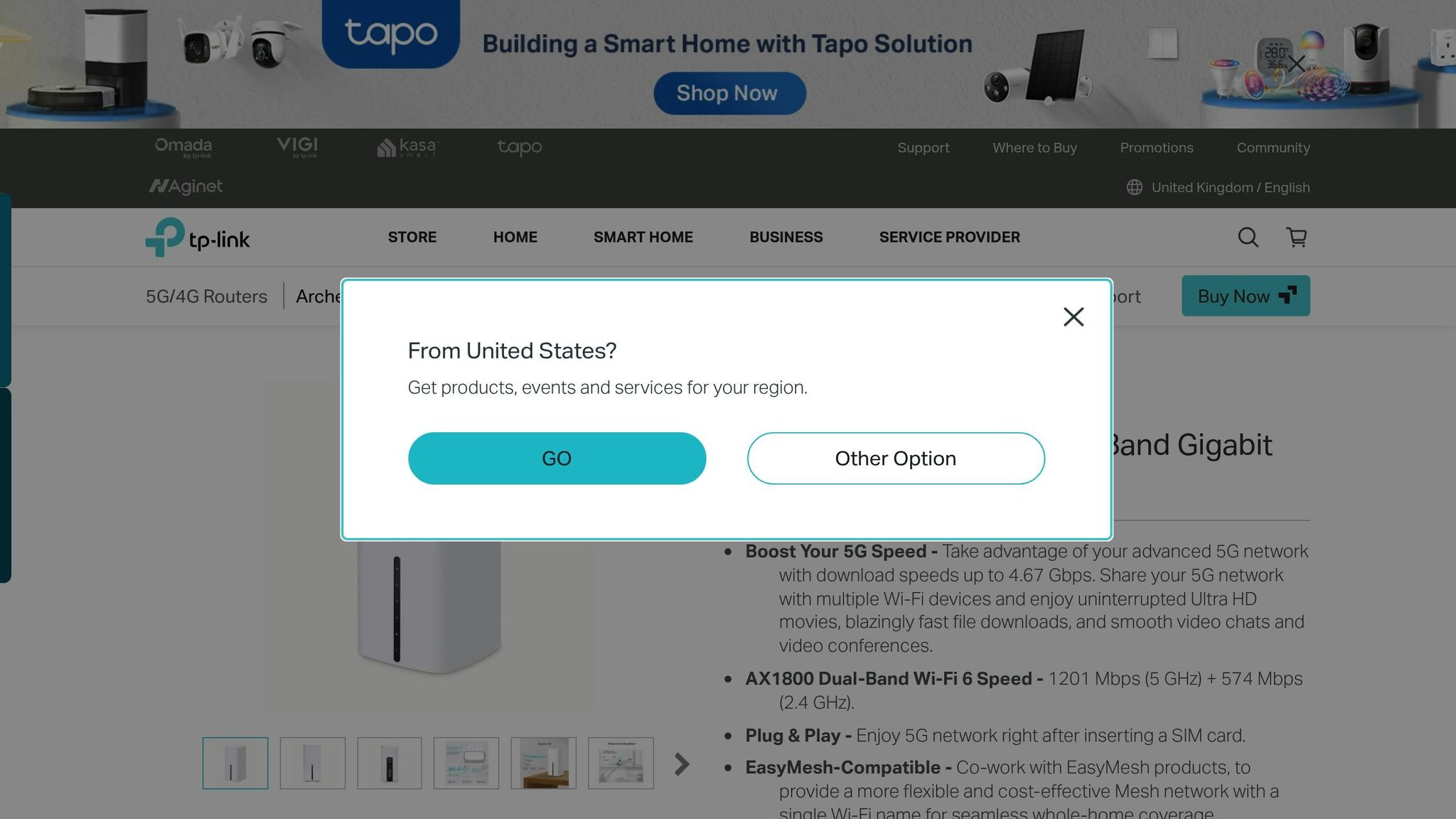
The TP-Link Archer NX200 is an excellent solution for those who want fast wireless internet without long-term wired contracts.
TP-Link Archer NX200 is a 5G router with Wi-Fi 6 technology, designed for locations where wired connectivity is not available or is too expensive. This device uses AX1800 dual-band Wi-Fi, which provides speeds up to 1201 Mbps on the 5 GHz band and 574 Mbps on the 2.4 GHz band. 5G connectivity can reach download speeds of up to 4.67 Gbps, and in 4G LTE Advanced mode, up to 300 Mbps, if conditions are optimal [17].
The router has one Gigabit WAN/LAN port and two additional Gigabit LAN ports, making it ideal for devices that require a stable wired connection, such as media servers or professional audio-visual solutions [17]. The Nano SIM slot allows for quick device setup without complex configurations [17].
The device features 8 internal 5G/LTE antennas and 2 Wi-Fi antennas. Additionally, there are 2 external SMA-F ports that allow for connecting additional antennas if the signal is weak. One user noted that by connecting a Netgear directional antenna via a coaxial connection, both 4G and 5G NSA signals achieved maximum strength [18].
The Archer NX200 also supports WAN Failover, which allows using the 5G connection as a backup internet source if the primary wired connection is lost [17]. The device is compatible with the TP-Link EasyMesh standard, so it can be integrated into a seamless network with other compatible devices [17]. In Europe, the price of this model is around €227.00, making it an attractive option for temporary projects, remote areas, or events that require fast and reliable 5G connectivity without long-term commitments [20].
Pros and Cons
After reviewing the specifications, it is worth highlighting the strengths and weaknesses of each device.
Each of these 5G routers has its unique applications. The Teltonika RUTX50 is designed for industrial environments – it ensures stable connectivity using dual SIM card slots with automatic failover [22][1]. This model is perfect for business solutions and harsh conditions, but its Wi-Fi 5 (802.11ac) standard limits the speed to 867 Mbps [22].
On the other hand, the newer Teltonika RUTC50 offers more possibilities. It supports Wi-Fi 6, has 1 GB of RAM and 8 GB of internal memory, making it suitable for edge computing and tasks where low latency is important [6]. This model achieves download speeds of up to 3.4 Gbps on the 5G network, making it ideal for projects that require speed and stability, such as professional audio-visual solutions [6].
Meanwhile, the TP-Link Archer NX200 is geared towards consumers. It features Wi-Fi 6 (AX1800) technology, ensuring speeds up to 1,201 Mbps on the 5 GHz band [21]. Additionally, the router supports EasyMesh, allowing it to create a seamless home network with other compatible devices [21]. However, this model only has one Nano SIM slot and operates within a temperature range of 0 °C to 40 °C, making it unsuitable for industrial conditions [21][19].
Regarding prices, the TP-Link Archer NX200 can be purchased for approximately €204.12 (ex. VAT) or €247.03 (inc. VAT), with prices reaching up to €277.09 in some locations [21][23]. Meanwhile, the Teltonika RUTX50 is a higher-end device, so its price exceeds that of consumer-oriented models [22].
| Feature | TP-Link Archer NX200 | Teltonika RUTX50 | Teltonika RUTC50 |
|---|---|---|---|
| Main purpose | Home / Small Office [22] | Industry / Business [22] | Edge Computing [6] |
| 5G speed | Up to 4.67 Gbps [21] | Up to 3.4 Gbps [1] | Up to 3.4 Gbps [6] |
| Wi-Fi standard | Wi-Fi 6 (AX1800) [21] | Wi-Fi 5 (802.11ac) [22] | Wi-Fi 6 (dual-band) [6] |
| SIM slots | 1 x Nano SIM [19] | 2 x SIM [22] | Dual SIM and eSIM [6] |
| Ethernet ports | 3 x Gigabit [19] | 5 x Gigabit [22] | Gigabit [6] |
| Mesh support | Yes (EasyMesh) [21] | No | No |
| Operating temperature | 0 °C to 40 °C [21] | Industrial range [1] | Industrial range |
Conclusions
The choice depends on your needs and use case. In Lithuania, the well-developed 5G infrastructure allows for maximizing the capabilities of the discussed devices [1].
For homes and small offices, the best choice would be the TP-Link Archer NX200. This router, supporting Wi-Fi 6 technology and offering up to 4.67 Gbps 5G speed, provides excellent value for money [25].
When it comes to solutions for business and industry, it's worth considering the Teltonika RUTX50 or RUTC50. The RUTX50, although with Wi-Fi 5, has dual SIM card slots with automatic failover, making it a reliable choice for critical tasks [22]. Meanwhile, the RUTC50, supporting Wi-Fi 6 and offering up to 3.4 Gbps 5G speed, is suitable for professional audio-visual projects requiring low latency and high throughput [3].
It is important to choose the most suitable device for different areas of activity. Remote work specialists are advised to choose models with dual SIM card support – by using different operator networks, a stable connection can be maintained even if one signal is lost. For those living in rural areas or further away from cities, models with external SMA antenna connectors ensure better signal reception [24].
View all LTE and 5G network equipment
FAQs
Which 5G router to choose for home and industry?
For home use, reliable, easy-to-use, and efficient models that ensure stable connectivity for multiple devices are best. For example, you can choose Teltonika's RUTM50 or Ubiquiti RUTX series routers.
For industrial needs, industrial models such as Teltonika's RUTM08, RUTM09, or M-series routers are recommended. These devices stand out for their reliability, resistance to harsh environmental conditions, and ability to manage a large number of devices.
Is it worth using dual SIM and eSIM functions in Lithuania?
Dual SIM and eSIM functions in Lithuania are becoming an increasingly convenient solution for those who want more flexibility in managing their connectivity.
eSIM technology allows you to activate and change operators without a physical SIM card – everything happens digitally. This is especially useful if you travel frequently or want to quickly switch to another mobile network provider.
The dual SIM function allows you to use two different numbers in one device. This is a great solution for those who want to separate work and personal calls or use a local SIM card when traveling abroad.
However, it is important to check if your device supports these functions, as not all models and operators in Lithuania have fully integrated eSIM technology yet.
When are external antennas and SMA connectors needed?
External antennas and SMA connectors become necessary when you want to improve the 5G or 4G signal. This is especially useful in situations where the signal is weak or a more stable connection needs to be ensured. Such antennas can be connected to devices with SMA connectors to increase connection quality and reliability.


