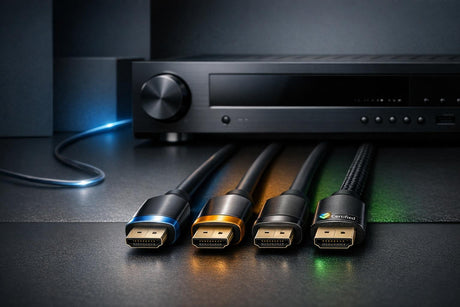
HDMI cables


Clicktronic
Clicktronic ultra-high-speed HDMI cable for 8K@60 Hz, 1.5m
Designed to bring the future to you! Clicktronic's Ultra Fast HDMI™ Cable delivers stunningly natural images and boasts the fastest transfer speeds on the market today.Regular price €35.00 EURUnit price /Unattainable

Goobay
Goobay premium class HDMI cable with Ethernet 1.5m 4K
HDMI™ Premium Certified Cable guarantees that the cable is present 4K/Ultra HD .Regular price €14.00 EURUnit price /Unattainable
 6 % discount
Goobay
Goobay Premium HDMI cable with Ethernet 3.0m 4K
HDMI ™ Premium Certified Cable guarantees that the cable is 4K / Ultra HD .Sales price €15.99 EUR Regular price 17.00 €Unit price /Unattainable
 66 % discount
Goobay
Goobay Optical Hybrid HDMI Cable, HDMI-HDMI (10m-30m)
The optical Hybrid HDMI ™ cable (optical fiber + copper) connects devices over long distances of up to 100 m without data loss - even in places with a high level of electromagnetic radiation.Sales price From €39.99 EUR Regular price 59.00 €Unit price /Unattainable

Clicktronic
Clicktronic high-speed HDMI cable with Ethernet and Ultra HD, 1.5m
Enjoy movies and games with high definition and dazzling quality even when viewing in 3D.Regular price €17.00 EURUnit price /Unattainable

In-Akustik
Cable HDMI-HDMI plugs 1.5m (HDMI 2.0) In-Akustik STAR
Highest resolution FULL HD 2160p; 4K support, HD Audio 24Bit/192 kHz; HDMI 2.Regular price €14.99 EURUnit price /Unattainable

In-Akustik
Cable HDMI-HDMI plugs 5.0m (HDMI 2.0) In-Akustik PREMIUM
Metal plugs, maximum resolution FULL HD 2160p; 4K support, HD Audio 24Bit/192 kHz; HDMI 2.Regular price €29.99 EURUnit price /Unattainable
In-Akustik
HDMI kit for wireless AV transmission In-Akustik HDMI KIT 3D
Supports Full HD 1080p Supports 3D Supports deep color Supports multi-channel audio formats Supports HDCP 2.Regular price €649.00 EURUnit price /Unattainable

Goobay
Goobay Premium High Speed HDMI 5m, 5m HDMI cable
This product is officially certified for Premium HDMI™.Regular price €24.99 EURUnit price /Unattainable

Proson
Proson Arctic HDMI 8K / 4K, signal HDMI cable (1m-10m)
Proson Arctic is a stylish HDMI cable with a protective braided outer part, supporting HDMI 2.Regular price From €25.00 EURUnit price /Unattainable

Goobay
Goobay Ultra High Speed HDMI™ Sharkskin Grey, signal HDMI cable (0.5m - 5m)
Goobay Plus series in "Sharkskin Gray" color, slim, elegant metal design.Regular price From €8.99 EURUnit price /Unattainable

Goobay
Goobay 8K AOC Ultra High Speed HDMI, optical HDMI cable (10m)
Goobay Optical Hybrid Cable - ideal for connecting devices up to 100 m away, providing much greater flexibility and higher transmission speeds than conventional copper cables.Regular price €49.99 EURUnit price /Unattainable

Frequently Asked Questions (FAQ)