

Headphone drivers are a key component that determines sound quality. There are three types of drivers on the market today: dynamic , planar magnetic , and electrostatic . Each has its own strengths and limitations, so the choice depends on your needs, budget, and listening habits.
- Dynamic : Versatile, affordable, strong bass reproduction, no amplifier required.
- Planar magnetic : Lower distortion, accurate sound, requires more power.
- Electrostatic : Extremely detailed, fast response, requires a special amplifier.
Table: Quick comparison overview
| Type | Price (€) | Energy demand | Sound characteristics | Usage |
|---|---|---|---|---|
| Dynamic | Low-high | Small | Strong bass | Everyday, mobile |
| Planar magnetic | Medium-high | Medium-high | Accurate, deep sound | Professional, home |
| Electrostatic | High | Very high | Transparent, detailed | Stationary, audiophile |
Choose according to your music style, budget and usage environment. If you like strong bass, choose dynamic. If you are looking for sound detail and accuracy, consider planar or electrostatic options. To learn more or get help, contact AUTOGARSAS.LT .
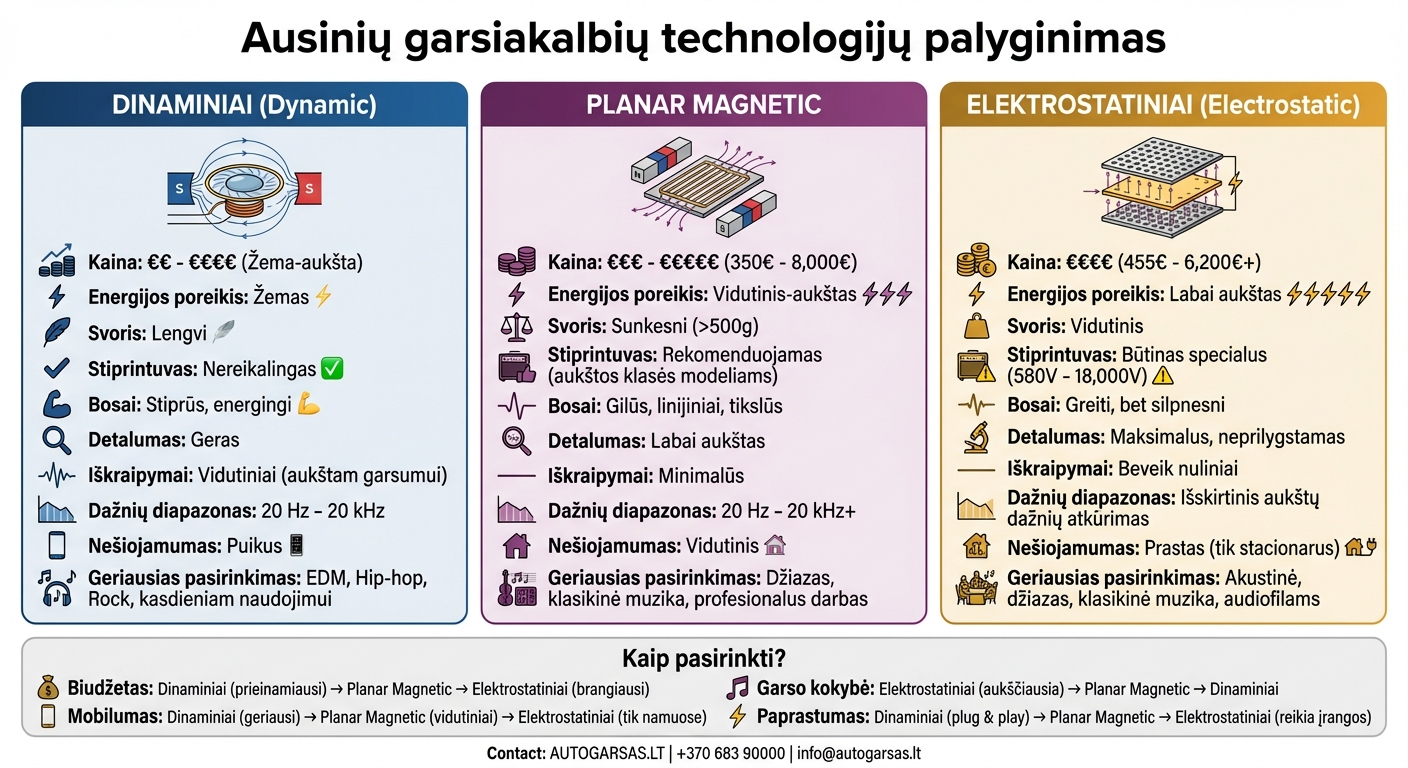
Comparison of headphone speaker types: dynamic, planar magnetic and electrostatic
1. Dynamic speakers
Operating principle
Dynamic speakers , also known as moving coil speakers, operate on the principle of electromagnetic induction. They consist of a fixed magnet (usually neodymium) and a voice coil attached to a diaphragm. When an electrical signal flows through the coil, a magnetic field is created that interacts with the magnet and causes the diaphragm to move back and forth, thus producing sound. [4] [1] . The size of these diaphragms typically ranges from 20 mm to 50 mm in diameter. [1]
Sound characteristics
Dynamic speakers are known for their strong bass reproduction , as their diaphragm can displace a large volume of air. Modern high-end headphones with dynamic speakers can reproduce frequencies as low as 20 Hz, although older models were often limited to 50 Hz [4] [1] . However, because the diaphragm moves from the center (where the voice coil is attached), not all parts of it move equally. This can lead to distortion and loss of detail, especially at high volumes [1] .
"Dynamic speakers (also known as moving coil speakers) are the most common and least expensive type of speaker. They can reproduce the full frequency range and are known for their excellent bass response in music." – Cayla Menges, Moon Audio [1]
These features make dynamic design a popular choice, but they also pose certain technical challenges.
Advantages
Dynamic speakers have several significant advantages. First, they require little power - they do not require a dedicated amplifier, making them easy to integrate with a variety of devices [1] [3] . In addition, they are cost-effective to manufacture, making them used in both budget and high-end headphones, such as the Meze 99 Classic and the Sennheiser HD 800S [1] [3] . Another advantage is their light weight, which makes headphones with dynamic speakers more comfortable to wear for long periods of time [2] .
Restrictions
Despite their advantages, dynamic speakers also have disadvantages. One of the main ones is distortion at high volumes , as the diaphragm cannot move uniformly across its entire surface. In addition, natural resonances between 50 Hz and 200 Hz can cause bass or low-mid frequencies to be boosted, which can lead to a loss of detail [1] [3] . Compared to planar or electrostatic speakers, dynamic models often have lower resolution. Because they produce a spherical sound front, their spatial sound and instrument positioning may not be as accurate as planar models [5] .
Next, we will look at how these advantages and disadvantages compare to other technologies.
2. Planar Magnetic Speakers
Operating principle
Planar magnetic speakers work by using an extremely thin diaphragm with electrical conductors on it. This diaphragm is sandwiched between two arrays of magnets. When an electrical signal flows through the conductors, an electromagnetic field is created that interacts with the magnetic field. This causes the diaphragm to move smoothly and produce sound [5] .
Unlike dynamic speakers, which emit spherical sound waves, planar magnetic technology creates flat sound waves. This allows for spatial sound and extremely precise instrument positioning [5] .
Sound characteristics
These speakers are distinguished by their extremely accurate and deep bass reproduction, which reaches as low as 20 Hz [4] . Dynamic speakers often lose volume in the low frequency range, and the planar magnetic design, due to the simultaneous movement of the diaphragm, ensures lower distortion even at high volumes [5] .
"Planar magnetic headphones often have a more linear bass extension than dynamic driver headphones... resulting usually in a more 'clean' sounding bass response." – Headphones.com [4]
Additionally, users praise the clear sound, fast response, and excellent instrument separation of these speakers, which provide an exceptional listening experience. However, like any technology, it has its limitations.
Advantages
One of the main advantages of planar magnetic speakers is their extremely accurate sound reproduction. Since the conductors are evenly distributed across the entire diaphragm, distortion is minimal, and the response is fast and precise. The lightweight diaphragm design allows for the reproduction of even the smallest sound nuances. In addition, due to the larger driver size (from 20 mm in IEM models to more than 100 mm in full-size headphones), these speakers create a spatial sound and a deep sound image [5] .
Restrictions
Despite their many advantages, planar magnetic speakers also have some disadvantages. Some models, such as the HiFiMAN Ananda , can be used with mobile devices, but high-end models, such as the HiFiMAN Susvara , require more power and special amplifiers to fully exploit their capabilities. In addition, due to the massive magnets, these headphones are often heavier - some models weigh more than 500 g. Planar magnetic headphones also have a lower dynamic response compared to some dynamic models.
3. Electrostatic speakers
Operating principle
Electrostatic speakers are distinguished by their exceptionally detailed and fast response, which complements the range of premium solutions offered by AUTOGARSAS.LT. Instead of electromagnetism, they use static electricity. Their design is based on an extremely thin, almost weightless diaphragm, fixed between two perforated metal plates, called stators [1] [6] .
This diaphragm receives about 580 V DC, and the stators transmit an audio signal, one positive, the other negative. The resulting electric field pulls and pushes the diaphragm, causing it to vibrate. These vibrations push air through the perforations, thus creating sound. [1] [6]
Because the diaphragm has no additional mass, such as coils or conductors, it responds instantly to signals. This allows for extremely accurate and fast response. This unique operating principle and sound reproduction process makes electrostatic speakers unique [1] [6] .
Sound characteristics
Electrostatic speakers are known for their clear, detailed, and fast sound without distortion. [1] They are particularly good at reproducing high frequencies and the most subtle nuances of sound, making them a favorite among audiophiles for listening to acoustic, jazz, or classical music.
"Electrostatic headphones are frequently considered the most transparent, natural, detailed sounding listening devices possible. This is due to the extremely quick transient response of their ultra-thin driver elements." – HeadAmp [6]
However, due to the weaker static force compared to electromagnetic design, electrostatic speakers have less energy in the low frequencies. Newer models such as the Dan Clark Audio Corina and STAX SR-X9000 have significantly improved bass reproduction, but still cannot match the "impact" of dynamic or planar magnetic speakers. [6] [5]
Advantages
Electrostatic speakers are characterized by extremely accurate sound reproduction. Their main advantages are:
- Unparalleled detail in high frequency reproduction.
- Almost zero distortion.
- Extremely fast response due to lightweight diaphragm [1] [6] .
- A flat sound wave that provides excellent surround sound and precise instrument positioning [5] .
Restrictions
The main drawback of this technology is the need to use a special amplifier (or "energizer") to supply the high voltage required. This means that electrostatic speakers cannot be connected to standard headphone jacks or mobile devices. [1] [6]
It is also one of the most expensive speaker technologies, with entry-level models starting at €455, while high-end models can cost as much as €6,200. [6] [7] These characteristics make electrostatic headphones more suitable for stationary use at home and not for mobility. [1]
sbb-itb-02aace5
Advantages and disadvantages
Like any other technology, different types of headphones have their pros and cons, which determine their suitability for various situations. AUTOGARSAS.LT experts advise evaluating several key criteria before making a decision.
Here is a brief overview of the main technologies.
Dynamic speakers are popular for their versatility and affordability. They work well with a variety of devices, from smartphones to computers, and don't require an additional amplifier. They're a great choice for everyday use or travel. However, at higher volumes, distortion can occur because the diaphragm moves unevenly—air is only pushed from the center, and the edges can wobble [1] .
Planar magnetic speakers offer lower distortion and accurate reproduction because the entire diaphragm moves in unison [1] . They are particularly suitable for professional audio work or home listening where every detail counts. Some models, such as the HiFiMAN Susvara, require high power, while others, such as the HiFiMAN Ananda, can also be used with mobile devices [2] . Prices for these headphones range from €350 ( HiFiMAN Sundara ) to €8,000 (HiFiMAN Susvara) [2] [4] .
Electrostatic speakers are the most luxurious and demanding option. They require a special amplifier (energizer) that supplies voltages from 580 V to as much as 18,000 V [1] [8] . In addition, these headphones require special care - they are sensitive to dust and moisture, so after use they must be turned off and the connector discharged [8] . This is a stationary solution for those who seek maximum sound detail and transparency.
| Criterion | Dynamic | Planar Magnetic | Electrostatic |
|---|---|---|---|
| Sound characteristics | Natural sound, energy | Clarity, speed, excellent instrument separation | Transparency, detail, "ethereal" sound |
| Bosses | Strong impact | Deep, linear, low distortion | Fast but lacks physical impact |
| Price | Low to high (most affordable) | Medium to very high | Very high (requires special amplifier) |
| Portability | Excellent (lightweight, easy to handle) | Medium (often heavy, requires power) | Poor (requires stationary amplifier) |
| Energy demand | Low (works with most devices) | Medium to high | Very high (specialized equipment) |
Conclusions
Each technology has its place in the audio world. Dynamic speakers remain the most popular choice due to their versatility and affordability – they are perfect for everyday use, are compatible with a variety of devices and provide an energetic, lively sound. Planar magnetic technology offers a new level of detail – it accurately separates instruments, responds quickly and has minimal distortion, making it an ideal choice for both professional work and pleasant listening at home. Meanwhile , electrostatic speakers , renowned for their transparency and detail, are designed for those looking for an exceptional audio experience.
When choosing headphones, consider your budget and listening habits. If you like energetic music like EDM, hip-hop, or rock, dynamic drivers are a great choice. Planar magnetic headphones are more suitable for jazz or classical music fans, while electrostatic models will satisfy audiophiles seeking impeccable transparency.
It's important to note that before purchasing planar or electrostatic headphones, it's worth making sure you have the right amplifier. If mobility is a priority, dynamic speakers will be the most practical choice, while planar and electrostatic models are better suited for stationary use at home.
Consider your audio needs and usage environment – the right headphones can completely transform your listening experience. The AUTOGARSAS.LT team is ready to help you choose the most suitable option for your needs and budget. Our experts advise on technical specifications, such as impedance or sensitivity, and offer personalized solutions, ensuring that you have the entire audio ecosystem you need: amplifiers, cables and other accessories.
Contact us by phone +370 683 90000 or by e-mail info@autogarsas.lt , and we will help you find the perfect solution for your listening needs.
FAQs
What is the difference between dynamic and planar magnetic headphone speakers?
Dynamic and planar magnetic headphone drivers differ in their design and sound reproduction principle. Planar drivers use a flat, ultra-thin membrane sandwiched between powerful magnets. When an electric current flows through the membrane, a magnetic field is created that moves the entire membrane evenly. This allows for extremely precise and detailed sound reproduction. Dynamic drivers , on the other hand, operate using a cone- or dome-shaped membrane that is moved by a magnet and a voice coil. This mechanism creates an energetic and powerful sound.
Planar speakers are characterized by fast sound reproduction, high detail and a wide sound stage, but they are often heavier (more than 500 g) and require a more powerful amplifier. Dynamic speakers, on the other hand, are lighter, cheaper and have a stronger bass response, although they can sometimes cause more sound distortion. When choosing between these two types, it is important to assess your needs: planar speakers are more suitable for those who seek the highest sound quality, while dynamic speakers are more convenient for everyday use.
Why do electrostatic headphone speakers need a special amplifier?
Electrostatic headphone drivers use a high-voltage electric field to produce sound, so they require a special amplifier. Conventional amplifiers simply cannot provide the necessary voltage level with low current gain, making them unsuitable for this type of technology.
These special amplifiers allow the electrostatic speakers to operate at maximum efficiency, delivering extremely accurate and detailed sound. If you are considering purchasing this type of headphones, do not forget that an additional amplifier is a necessary part of them. Only then will you be able to take full advantage of this technology.
What type of headphones are best for listening to classical music?
For classical music lovers, it is crucial to choose headphones that deliver a wide sound field , precise instrument separation, and natural-sounding midrange . Planar magnetic and electrostatic headphones are often considered the best choice, as they reproduce incredible detail and the most subtle nuances of music.
Planar magnetic headphones offer a wide frequency range and impeccable accuracy, so every orchestral instrument sounds clear and precise. Meanwhile, electrostatic headphones further emphasize the transparency of midrange frequencies and give the feeling of listening to a live concert right in the concert hall. For a cheaper solution, it is worth paying attention to high-quality dynamic headphones with open cabinets - they can also perfectly convey the beauty of classical music.
AUTOGARSAS.LT offers a wide selection of all these types of headphones, so everyone will find a model that will allow you to immerse yourself in the world of classical music and enjoy its magic.


