

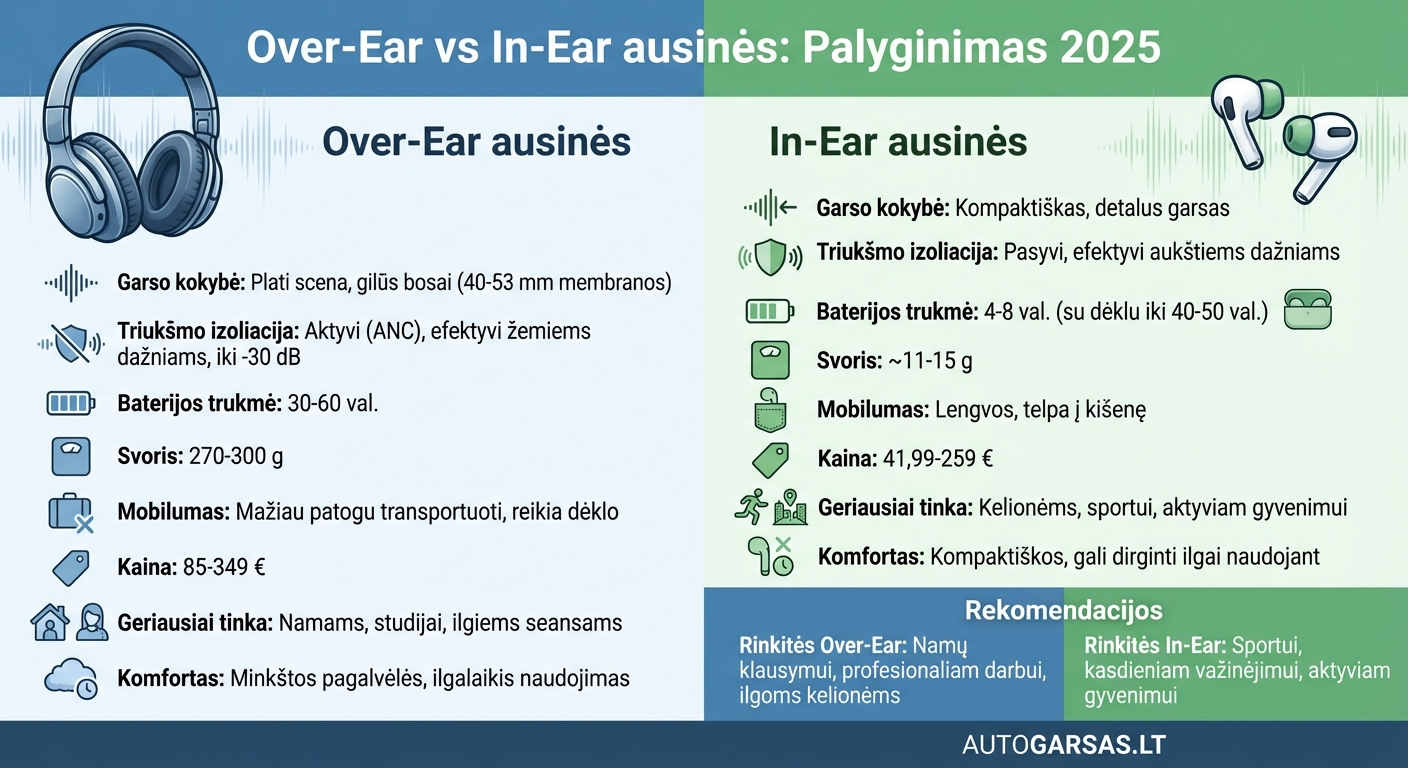
Is 2025 the year to choose between over-ear and in-ear headphones? Here's a quick guide to help you decide:
- Over-ear headphones : Best for home or studio use. They offer a wider soundstage, deeper bass, longer battery life (30-60 hours), and comfort for long listening sessions. However, they are larger and less portable.
- In-ear headphones : ideal for an active lifestyle, sports or travel. Compact, lightweight, with good passive noise cancellation, but shorter battery life (4-8 hours, with a case up to 40-50 hours).
Choose according to your needs:
- For travel and sports – in-ear.
- For home listening and long sessions – over-ear.
Quick comparison table:
| Parameter | Over-Ear | In-Ear |
|---|---|---|
| Sound quality | Wide stage, deep bass | Compact, detailed sound |
| Noise insulation | Active (ANC), effective for low frequencies | Passive, efficient for high frequencies |
| Battery life | 30–60 hours | 4-8 hours (with case up to 50 hours) |
| Mobility | Less convenient to transport | Lightweight, fits in your pocket |
| Price | €85–349 | €41.99–€259 |
AUTOGARSAS.LT in Kaunas offers the opportunity to try both types and find the most suitable model for your needs.
Over-Ear vs In-Ear Headphones Comparison 2025: Key Differences
Over-Ear vs In-Ear Headphones Explained | Technics Hi-Fi Essentials
Sound Quality: Over-Ear vs In-Ear Headphones
Over-ear headphones offer a wider soundstage because their ear cushions completely surround the ears. This allows sound waves to interact naturally with the shape of the ears, reminiscent of listening to sounds in the real world [3] . This design is particularly appealing to audiophiles and those looking for a spacious, “outside the head” sound. In addition, larger diaphragms provide deeper and more perceptible bass. For example, the Audio-Technica ATH-AVC500 model with 53 mm diaphragms and bass ports guarantees strong, deep bass [4] . On the other hand, the Technics EAH-A800 with a 40 mm diaphragm ensures balanced reproduction of low and high frequencies [1] . While over-ear headphones are famous for their sense of space, in-ear models offer other advantages, such as compactness and effective noise isolation.
In-ear headphones fit directly into the ear canal, so the sound is often felt “inside the head” [3] . However, it is this design that allows for excellent passive noise isolation, which in some cases even outperforms active noise cancellation (ANC), especially in the high-frequency range [3] . High-end models, such as the FiiO F9 Pro (€169), use a hybrid system - a dynamic speaker for bass and two armature speakers for mid and high frequencies. This combination ensures detailed and balanced sound, while maintaining a minimalist design [2] .
"Over-ear headphones can more effectively recreate a realistic sense of space than in-ear headphones; this is often referred to as 'soundstage.'" – SoundGuys [3]
Noise isolation also depends on the type of headphones and the technology used. Over-ear models with ANC, such as the Sony WH-1000XM6 or JBL Tour One M3 , are excellent at blocking out low-frequency noise, such as the roar of airplane engines or traffic, by up to 30 dB [5] . Meanwhile, in-ear headphones, due to their airtight seal, are better at blocking out high-frequency sounds [3] . These differences allow you to choose the right model for your daily needs and usage habits.
The main differences between these two types of headphones are presented in the table:
| Parameter | Over-Ear Headphones | In-Ear Headphones |
|---|---|---|
| Soundstage | Wide and natural; sound interacts with the shape of the ear [3] | Narrow; sound is felt "inside the head" [3] |
| Bass depth | Deep and tactile; 40–53 mm diaphragms [3] [4] | Precise and robust; depends on tightness [3] [2] |
| Noise insulation | Great with ANC; effective for low frequencies [5] | Excellent passive insulation through tightness [3] |
Comfort and everyday use
Over-Ear Headphones: Comfort for Long Listening
Over-ear headphones are a great choice if you plan to listen to music or watch movies for a long time. Their soft, ear-hugging cushions and adjustable headband ensure even pressure distribution. For example, the Technics EAH-A800 (€349) model stands out with its extremely soft cushions and perfectly balanced weight (270-300 g), but prolonged use can cause heat buildup [1] .
Because of these features, over-ear headphones are best suited for stationary use, such as watching movies at home, working in a studio, or working in an office where movement is minimal.
In-Ear Headphones: Practicality for an Active Life
Meanwhile, in-ear headphones are designed for active people who value lightness and mobility.
These headphones are small, lightweight, and fit snugly in your ears, making them ideal for sports or everyday use. For example, the Klipsch T5M (€79) weigh just 11.6g and feature patented oval silicone tips that ensure comfort even during intense activities [6] . However, prolonged use can cause ear irritation, and the battery life – between 4 and 8 hours – can be a limiting factor [3] .
Nevertheless, their compactness is unbeatable - the headphones easily fit into a pocket or small handbag. When choosing between these two types, it is worth considering your daily habits: do you listen more often at home, or are you constantly on the go? The choice depends on your lifestyle.
sbb-itb-02aace5
Portability and battery life
Portability: Size and storage options
The in-ear headphones are extremely compact - they are easy to put in your pocket, and the charging case not only protects but also ensures that the headphones are always ready for use. This is a great choice for those who often travel by public transport or plane, where every free centimeter in luggage is important.
Over-ear headphones, on the other hand, take up more space. Some models, like the Bose QC45 or Sony WH-1000XM4 , fold into a compact shape, but newer models, like the Sony WH-1000XM5 , only fold flat, requiring a larger case. These headphones are more suitable for those who travel with more spacious carry-on luggage or larger backpacks. Now, let's look at how these design differences translate into battery life and charging capabilities.
Battery life and charging in 2025
Battery life is one of the most important aspects when choosing headphones. Over-ear headphones can last for 30-60 hours on a single charge, even with active noise cancellation enabled. For example, the Technics EAH-A800 (€349) offers an impressive 50 hours of battery life, and the quick-charge feature allows you to charge the headphones for another 10 hours in just 15 minutes. This is a great option for long trips or flights when you don't want to worry about the battery running out.
In-ear headphones, while smaller, also offer a decent amount of battery life. They last for 4-8 hours on a single charge, but a charging case can extend that to 40-50 hours. For example, the Soundcore Liberty 5 ($129.99) offer 8 hours of battery life on a single charge, and the case adds another 48 hours. Even more impressive, just 10 minutes of charging is enough for an additional 5 hours of listening. The case automatically charges the headphones when they’re placed in the case, so there’s no need for extra cables.
Technologies like USB-C and Bluetooth 6.0 ensure energy efficiency and stable connections with multiple devices at once. Premium over-ear models like the Bose QuietComfort Ultra (2nd Gen) (€399) even let you listen to music while charging, providing even more flexibility and convenience for everyday use.
Which headphones to choose according to your needs
For travel and daily commuting
Given the importance of comfort and sound quality, choosing headphones depends largely on how you plan to use them.
If you travel a lot on public transport, in-ear headphones are a great option. They’re small, lightweight and charge quickly, making them ideal for short trips. For example, the JBL TUNE 500BT (€41.99) have a quick-charge feature that gives you an hour of listening time after just 5 minutes of charging. [9] In addition, active noise cancellation (ANC) helps effectively reduce ambient noise, such as the roar of engines.
For longer journeys, such as by plane or train, over-ear headphones are a better choice. Not only are they comfortable to wear for longer periods of time, but they also provide better low-frequency isolation, making the journey more comfortable. [8] [10] We will discuss below how different headphones are suitable for different situations.
For home and studio listening
For home or studio use , over-ear headphones are a great choice, as they provide a wider soundstage and good isolation from external noise. For example, the Audio-Technica ATH-AVC500 (€85) model with 53 mm speaker membranes provides deep bass and detailed sound [4] [12] . In addition, soft cushions and an automatically adjusting headband ensure comfort even during longer listening sessions.
Open-back over-ear headphones are recommended for professional studio use. They allow sound to interact with the environment, resulting in a natural and accurate sound. This design reduces pressure on the ears and helps prevent fatigue during long hours of work. [13]
For training and outdoor activities
People with active lifestyles need headphones that meet their needs and the pace of life.
In-ear headphones are perfect for workouts. They are lightweight, stay firmly in your ears thanks to special hooks or tips, and their compact design does not hinder movement. The FiiO F9 PRO (€169) with its hybrid 3-speaker system and replaceable cable is a great choice even for intense workouts [2] .
Meanwhile , over-ear headphones are not suitable for exercising. They are heavier, can slip off your head when you move, and the large cushions often cause sweating and discomfort. [15] If you like to run or ride a bike, it is worth choosing open-type in-ear headphones , which allow you to hear your surroundings and ensure safety on the street. [14]
Use case comparison
| Activity | Recommended type | Specific model (AUTOGARSAS.LT) |
|---|---|---|
| Travel by public transport | In-Ear (with ANC) | JBL TUNE 500BT (€41.99) [9] |
| Long flights and trips | Over-Ear | Bose QuietComfort Ultra (€299) [11] |
| Home cinema and music listening | Over-Ear | Audio-Technica ATH-AVC500 (€85) [4] |
| Sports and training | In-Ear (sports models) | FiiO F9 PRO (169 €) [2] |
| Outdoor running | Open-type In-Ear | Bose Ultra Open Earbuds (€259) [11] |
Conclusion
In 2025, the choice of headphones will depend on your lifestyle and needs. If you value a wide range of sound, deep bass, and comfort for extended listening, over-ear headphones are a great choice. They are especially suitable for use at home or in the studio, and also offer the longest battery life along with active noise cancellation (ANC) [1] . This solution is perfect for both work in the office and relaxing at home.
Meanwhile, in-ear headphones are ideal for active people. They are lightweight, compact, stay in place even when moving, and provide good passive noise isolation [3] [7] .
When choosing headphones, it is important to consider several key things: Bluetooth codec compatibility (e.g. AAC for iOS devices, LDAC or aptX for Android devices) [1] [3] , IP protection rating if the headphones will be used for sports [3] , and the ability to try them before buying.
AUTOGARSAS.LT offers professional consultations and the opportunity to try out headphones in Kaunas. Our experts will help you choose headphones that will meet your needs and budget.
FAQs
Which headphones are best for long-term listening at home?
For long-term listening at home, one of the most comfortable options is over-ear headphones . They completely surround the ears, which provides excellent isolation from ambient noise and allows you to enjoy high-quality sound. The larger speakers in this type of headphones ensure rich bass and a wide sound stage, and the soft, breathable ear cushions help prevent discomfort even after prolonged listening.
If you're looking for freedom of movement, wireless over-ear headphones are a great option. They often have noise-canceling features that allow you to fully immerse yourself in your music, even in the presence of ambient noise. On the other hand, wired headphones are more suitable for those who value stability and don't want to worry about charging the battery. They also often provide extremely accurate sound reproduction.
In short, if comfort, durability, and high-quality sound are important to you, over-ear headphones are a great choice for listening at home.
How to choose the right headphones for sports and active life?
When choosing headphones for sports, the most important things to consider are comfort , stability , and moisture resistance . If you plan on doing intense sports, in-ear headphones with silicone or foam tips are a great choice. They fit snugly in your ears, so they stay in place even during active movement, and the materials help protect against sweat. If you're looking for a wider sound range, you can choose over-ear models with special holders designed for sports. However, these models are usually larger and less comfortable to wear.
What else should you pay attention to?
- Sweat resistance : Choose headphones with an IPX4–IPX7 certification that ensures protection against moisture.
- Battery life : Sports headphones should last at least 6-10 hours of continuous use, and up to 30 hours with the charging case.
- Sound quality : Bright bass can be a great motivator during workouts, so it's worth looking for models that provide high-quality and rich sound.
- Stability : Choose headphones with adjustable tips or magnetic mounts so they stay in place even during active movement.
AUTOGARSAS.LT offers a wide range of sports headphones to suit all budgets – from budget options to premium models. In addition, all headphones are sold with an official warranty. To find the model that suits you best, we recommend trying out several different headphones – this way you will ensure that the choice meets your needs and expectations.
What is the difference in noise isolation between over-ear and in-ear headphones?
Over-ear headphones offer better passive noise isolation because their large cups completely cover your ears, effectively blocking out external sounds. This design allows you to focus on your music or other content even in noisy environments.
In-ear headphones isolate noise differently – they fit directly into the ear canal, so a proper fit is crucial. If the ear tips fit well, they can offer fairly effective noise isolation, but if they fit poorly, the isolation can be weaker.
If your goal is to minimize ambient noise, over-ear headphones will often be a better choice. However, in-ear headphones are distinguished by their compactness and lightness, making them especially convenient when actively moving or traveling.


