

An integrated amplifier is a simple solution that combines the functions of a preamplifier and a power amplifier in one device. It is suitable for small spaces and beginners, and prices in Lithuania range from €255 to €1,999. A power amplifier , on the other hand, is designed only to amplify the signal and requires a separate preamplifier . It is suitable for large spaces and high-quality sound systems , but costs more and takes up more space.
Key differences:
- Integrated amplifier : simple, compact, cheaper.
- Power amplifier : more powerful, more flexible, better sound quality.
The choice depends on your budget, space size, and plans for future system upgrades.
What is an integrated amplifier?
An integrated amplifier is a device that combines the functions of a preamp and a power amp in a single housing. In other words, one device does the work of two components, so all you need to do is connect your speakers and audio source to get the system up and running.
Thanks to its compact size, such an amplifier not only saves space, but also simplifies the installation of the system. This is especially useful for smaller spaces or those who value minimalist interiors. In addition, integrated models often cost less than separate components, as their production is optimized, which reduces the overall cost.
Main features
Modern integrated amplifiers offer a wide range of features that ensure convenient use. Among them, you will often find:
- Built-in DAC (digital-to-analog converter) – perfect for digital sources.
- Bluetooth and Wi-Fi connectivity – allows you to stream music wirelessly.
- Phono inputs – for vinyl record players.
- Tone adjustment – the ability to change the balance of low and high frequencies.
- Pre-out outputs – allows you to add a separate power amplifier in the future.
When is it worth choosing an integrated amplifier?
An integrated amplifier is a great solution for home stereo systems , especially if you are looking for a simple and reliable solution. If you want to enjoy music in your living room or bedroom without complicated configurations, this device will be the right choice.
It is also ideal for small spaces where space is at a premium. In addition, many models have multiple inputs, so you can easily connect a TV, music player or other audio sources and conveniently switch between them. This is a practical and functional solution for those who value simplicity and versatility.
What is a power amplifier?
A power amplifier is a device designed to amplify an already processed audio signal to a level that can properly drive speakers. Unlike an integrated amplifier, a power amplifier does not perform the functions of a preamplifier, such as input selection, volume control, or tone control. Therefore, when using a power amplifier, it is necessary to have a separate preamplifier ( preamp ) that prepares the signal before passing it to the power amplifier.
This modular solution is most often used in high-quality audio systems , where the highest possible sound clarity and power are sought. Power amplifiers are characterized by low distortion levels and the ability to work with complex speaker systems. Since their design is optimized only for amplification, they provide better sound control and dynamics than universal integrated models.
Main features
Power amplifiers have a large power reserve. For example, some models can deliver 140 W into 8 ohms, and even more into 4 ohms. Class A amplifiers, although usually limited to 20-30 W, provide exceptional dynamics and accuracy, often surpassing the more powerful Class AB models.
Another important parameter is the damping factor (DF), which indicates how effectively the amplifier controls the speaker diffuser. High-end models can achieve DFs of 500 to 1000, using MOSFET technology and parallel transistors. This allows for accurate reproduction of low frequencies without distortion, even when using complex speakers [2] .
When is it worth choosing a power amplifier?
A power amplifier is a great option if you have a large room (over 30 m²) where you need to provide 100 dB or more of distortion-free sound. In such spaces, integrated amplifiers often do not have sufficient power reserve, which can result in weak or distorted sound [2] .
It is also suitable for low-sensitivity speakers (less than 88 dB/W/m) that require more power to achieve the desired volume. For example, bookshelf speakers with deep bass frequencies require an amplifier with high current headroom and high DF to ensure accurate control without distortion [2] . Power amplifiers are also ideal for home theater systems that require driving multiple channels and powerful subwoofers.
Integrated or power amplifier: the main differences
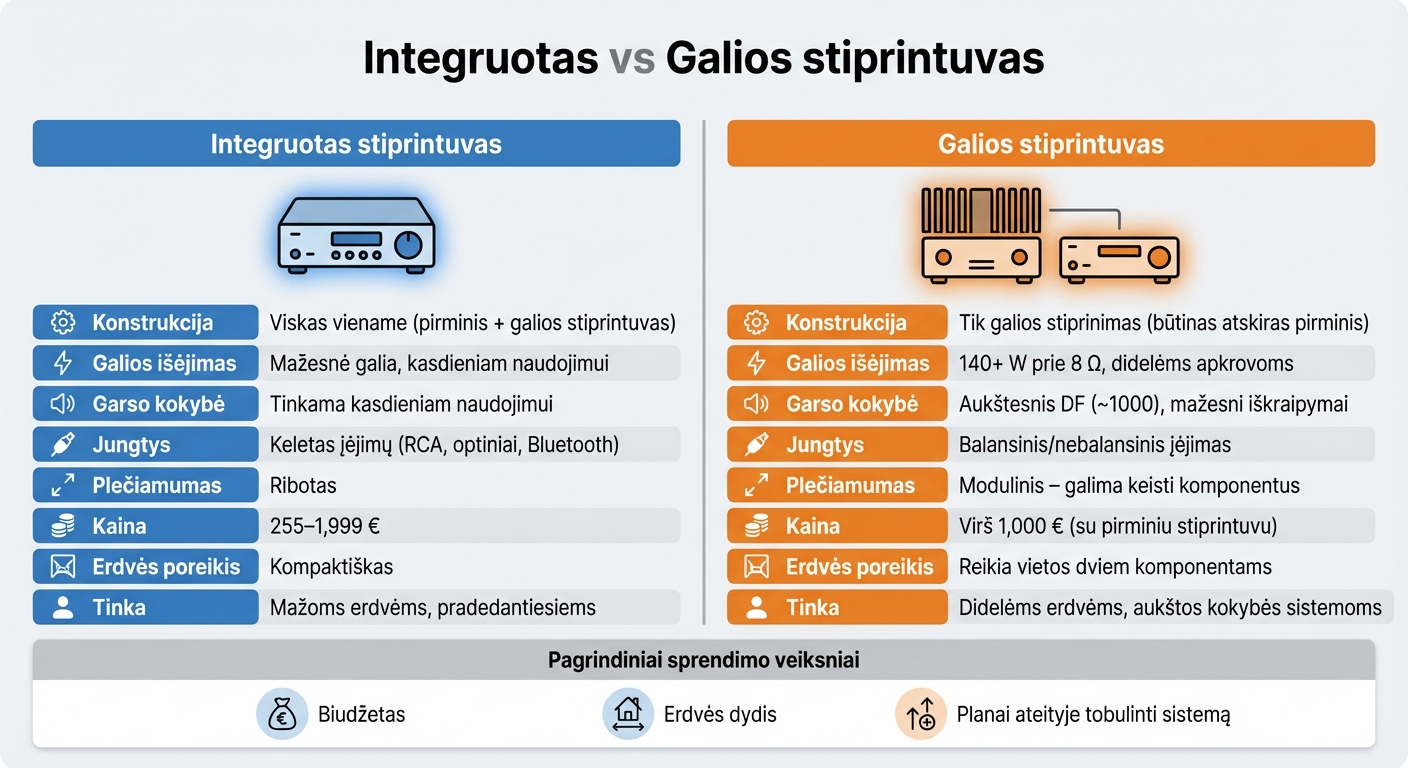
Comparison of integrated and power amplifier: key differences
When choosing between an integrated and a power amplifier, it's important to understand how these devices work and the flexibility they offer. An integrated amplifier combines a preamp, a power amplifier, and various inputs into one device. It's a great solution for those looking for simplicity and smaller spaces.
Meanwhile, the power amplifier is designed to amplify the already prepared signal to exploit the full potential of the speakers. However, it requires a separate preamplifier , which is why this system is modular. Using modern technologies such as MOSFETs, power amplifiers can achieve extremely high damping factors (DF), even up to ~1000, which allows for more precise control of low frequencies and reduced distortion [2] . These aspects become especially important when it comes to sound quality and functionality.
The choice is often determined not only by technical characteristics, but also by financial possibilities. Integrated amplifiers are often more economical, making them an attractive option for beginners. Meanwhile, power amplifiers, including a preamplifier, can cost more than €1,000, but offer greater expandability and higher sound quality, suitable for demanding systems [2] [4] .
Comparison table: integrated and power amplifier
| Aspect | Integrated amplifier | Power amplifier |
|---|---|---|
| Construction | All in one: preamp + power amplifier | Power amplification only – separate primary required |
| Power output | Lower power, suitable for everyday use | Often 140+ W into 8 Ω, optimized for high loads [2] |
| Sound quality | Suitable for everyday use | Higher DF (~1000) and lower distortion [2] |
| Connectors | Multiple inputs (RCA, optical, Bluetooth) | Usually only balanced/unbalanced input |
| Scalability | Limited – difficult to change integrated components | Modular – ability to replace components individually |
| Price | €255–€1,999 [4] | Over €1,000 (including preamp) [2] [4] |
| Space requirement | Compact – all in one device | Requires space for two separate components |
Power amplifiers also allow multiple components to be connected, for example in parallel or bridged configurations. This provides more power and improves dynamic range. [2] Such capabilities are especially valuable in professional systems or large venues where maximum control and power reserve are important.
sbb-itb-02aace5
How to choose the right amplifier
When choosing an amplifier, it's important to consider three main factors: the size of your room, the technical characteristics of the speakers, and your budget. These aspects will help you make a decision that will suit your needs.
Room size and power requirements
The size of the room directly determines how much power your amplifier should have. For small rooms up to 15 m², it is recommended to choose an amplifier with a power of 30–50 W at 8 Ω, especially if you are using bookshelf speakers with medium sensitivity (88–90 dB).
For medium-sized rooms (20-30 m²) , an amplifier with a power of at least 60-100 W at 8 Ω or 80-150 W at 4 Ω is advisable. This power is especially necessary if you are using floor-standing speakers. If the room is larger than 30 m² , it is worth considering more powerful integrated or separate power amplifiers, especially if you like to listen to music louder.
It is often emphasized in audiophile forums that while the actual listening volume is often only a few watts, the high power of the amplifier allows for accurate reproduction of dynamics and distortion-free bass control. This is especially important in larger spaces [2] .
Matching the amplifier and speakers
The technical characteristics of the speakers – sensitivity and impedance – are important when choosing the right amplifier.
- Sensitivity (dB) : If your speakers have low sensitivity (less than ~87 dB), you will need a more powerful amplifier, especially if you plan to listen to music louder or in a larger room [2] .
- Impedance (Ω) : 4 Ω speakers require more current than 8 Ω. Therefore, it is important to choose an amplifier with an RMS power rating of 1.0 to 1.5 times the minimum recommended power of the speakers. A weak amplifier, operating close to its limits, can cause distortion and even damage the speakers [5] .
Interestingly, even a 20–30 W Class A amplifier can sound better and drive speakers more efficiently than a more powerful Class AB amplifier , if the latter is operated close to its limits [2] .
Budget and future updates
Budget also plays a role. Integrated amplifiers , which cost between €255 and €1,999, are perfect for smaller apartments. They often combine an amplifier, network player, DAC, and even multiroom functionality into a single unit [3] .
Meanwhile, power amplifiers (often costing over €1,000) are more suitable for larger rooms or private homes. They allow you to create a modular system in which you can change individual components and customize the system to your needs. Although such a system requires a larger initial investment, it provides more flexibility in the future. If you have a clear plan and budget for future expansion, a modular solution can be a very practical choice.
Conclusion: find your amplifier AUTOGARSAS.LT

The final decision depends on your needs and the system you have. If you are looking for a compact solution, integrated amplifiers can be a great choice - they combine all the main functions in one device. Meanwhile, power amplifiers are more suitable for those who seek greater flexibility and the ability to change or improve individual system components in the future.
AUTOGARSAS.LT has been implementing high-quality audio and video projects since 1997 – from luxury car audio systems to exclusive home cinema rooms. In the store located in Kaunas, you can not only hear how different amplifiers sound, but also receive professional consultations live, by phone or e-mail. [1] . Many years of experience and professionalism guarantee that you will find a solution that will meet your needs, budget and space specifics.
In addition to a wide selection of amplifiers, AUTOGARSAS.LT also offers professional installation, individual consultations, a 24-month warranty, and free shipping on orders over €100 [1] .
View all Integrated Amplifiers
FAQs
Why choose an integrated amplifier for small spaces?
An integrated amplifier is an ideal solution for small spaces, as its compact design helps to make efficient use of space. Another important feature is its ease of installation. Since this device often combines several functions in a single housing, you can enjoy high-quality sound without additional devices or complex systems.
How to choose the right amplifier based on the size of the room and your needs?
To choose the right amplifier, it is important to consider the size of the room and the desired sound quality. If the room is small, a lower-powered amplifier will usually be a great choice - it will provide clear and balanced sound. However, if the room is larger, you will need a more powerful amplifier to maintain sound quality and spread evenly throughout the space.
AUTOGARSAS.LT offers a wide selection of amplifiers, so you can easily find a solution that will meet both your needs and the size of the room. If you have any doubts about which amplifier to choose, you can always contact our specialists - they will help you make the most appropriate decision.
When should you choose a power amplifier?
A power amplifier is a great solution if you are looking to improve sound quality, increase sound power, or use high-end audio systems in your home, car, or business environment. It is especially useful when your existing audio equipment requires additional power to operate at full capacity.
A power amplifier provides clearer, stronger and more detailed sound, making it an important investment for those seeking the highest quality audio experience. If you are unsure about which solution is best for your specific situation, AUTOGARSAS.LT specialists will be happy to help you choose the most suitable option.


