

Looking for better sound in your car? This guide will help you choose the right speakers based on your budget, audio needs, and car compatibility.
- Coaxial speakers : Easy to install, cost between €95 and €120, suitable for everyday use.
- Component speakers : Higher sound quality, price from €220, more complicated installation.
- Key specifications : Power (RMS), sensitivity (>90 dB is better for weaker systems) and impedance (usually 4Ω).
- Installation locations : Tweeters – in the A-pillars, woofers – in the doors or trunk.
- Budget : Basic upgrade from €100, full system – up to €2,000.
Tip : If you want a simple upgrade, opt for coaxial models. For those looking for high quality, component speakers are a better solution.
Below we will discuss how to choose the best option for your car.
Types of car speakers
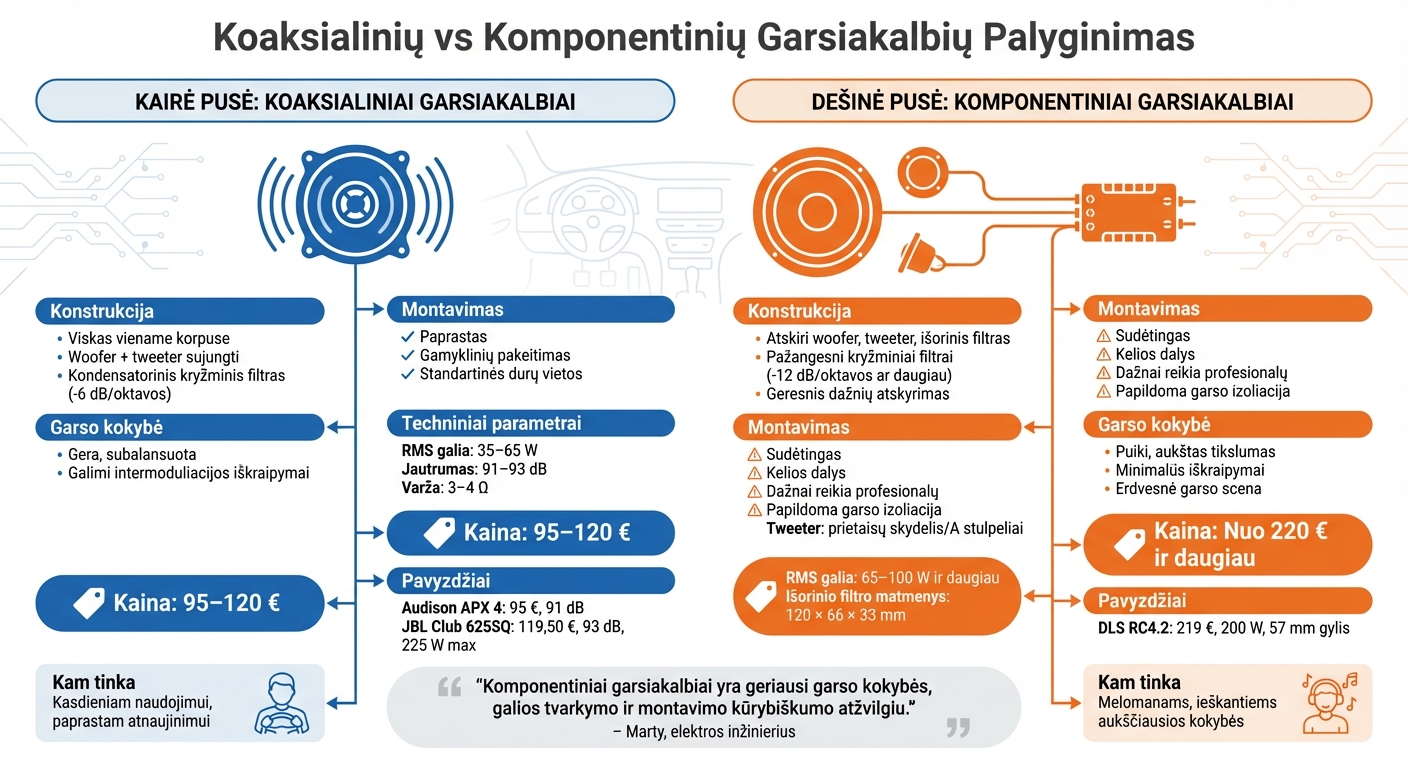
Comparing Coaxial and Component Speakers: Prices, Power, and Installation
Now that you've covered the basic selection criteria, it's time to figure out which speakers best suit your needs. There are two main types of speakers on the market: coaxial and component speakers. They differ in their design, installation complexity, and sound quality.
Coaxial speakers
Coaxial speakers are designed to combine a woofer and tweeter in a single housing. This design makes them ideal for replacing factory speakers. For example, the Audison APX 4 (priced at around €95.00, sensitivity at 91 dB) can be easily installed in standard door locations [9] . If you're looking for a higher-end option, the JBL Club 625SQ (priced at around €119.50) offers 93 dB sensitivity and 225 W of peak power [2] .
These speakers typically use a capacitor crossover filter with a -6 dB/octave slope to protect the tweeter from low frequencies. [7] While this filter helps balance the sound, it can cause intermodulation distortion. [7] [8] Coaxial speakers typically have an RMS power rating of 35 W to 65 W. Some models, such as the JBL GX602 , have a 3 ohm impedance, allowing for more efficient use of the factory head unit's power. [10] [2]
Component speakers
Component speakers are a great choice for those looking for even more accurate sound reproduction.
This type of speaker system consists of a separate woofer , tweeter and external filter. This allows for better frequency separation and higher sound quality. For example, the DLS RC4.2 (price about €219.00, 200 W power, 57 mm installation depth) requires additional space for the external filter, which has dimensions of 120 x 66 x 33 mm [11] .
"Component speakers are the best in terms of sound quality, power handling, choice of tweeter and woofer technology, and installation creativity." – Marty, electrical engineer and professional installer [7]
These systems often use more advanced crossover filters with a slope of -12 dB/octave or higher, so distortion is minimal. [7] [8] Tweeters can be mounted in the dashboard or A-pillars to project sound from ear level, creating a more spacious soundstage. [7] [8] However, installation is more complex, often requiring professional assistance and additional soundproofing. [1] [9]
| Feature | Coaxial | Component |
|---|---|---|
| Construction | All in one housing | Separate woofer , tweeter , filter |
| Installation | Simple (factory replacement) | Complex (multiple parts) |
| Sound quality | Good (balanced) | Excellent (high accuracy) |
| Price | From €95 to €120 | From €220 and up |
| Power (RMS) | 35-65W | 65-100 W and above |
sbb-itb-02aace5
Speaker specifications to look out for
To ensure great sound quality, it's important to understand the technical specifications of your speakers. Three key parameters—power, sensitivity, and impedance—directly affect audio performance and compatibility with your system. Let's take a look at how each one affects you.
Power handling (watts)
Power refers to how much power a speaker can handle from an amplifier without breaking down or distorting the sound. Of particular importance is RMS power, which shows how much continuous power a speaker can handle over a longer period of time - this is the most reliable indicator for everyday use.
Interestingly, an amplifier that delivers too little power can be more dangerous than one that delivers too much. If the amplifier cannot deliver enough power, clipping occurs, which can damage the voice coil much faster than clean, high power [12] .
"RMS power is your go-to figure for real, usable sound power." – Elite Auto Gear [12]
It is often recommended to choose an amplifier that delivers 1.5–2 times the RMS rating of the speaker. For example, if you are using a factory stereo (15–20 W RMS), it is better to choose speakers with high sensitivity (90 dB or more) to achieve good volume without an additional amplifier [12] .
Sensitivity
Sensitivity indicates how much volume a speaker can produce from a given amount of power. High sensitivity allows for higher volume levels even with a lower power source. For example, the MATCH UP X4MB-FRT model, designed for Mercedes-Benz upgrades, has a sensitivity of 89 dB (1 W/1 m) [14] and works ideally with a DSP amplifier.
| Speaker model | Sensitivity | Power (RMS) | Recommended source | Price |
|---|---|---|---|---|
| JBL Club 625SQ | 93 dB | 75W | Factory radio or amplifier [2] | €119.50 |
| MATCH UP X4MB-FRT | 89 dB | 60W | DSP / external amplifier [14] | €159.00 |
If you plan to use an external or DSP amplifier, you may want to choose speakers with a slightly lower sensitivity (below 90 dB), as the amplifier will provide sufficient power for efficient operation [14] .
Resistance
Impedance is the electrical resistance of a speaker to the flow of current, measured in ohms (Ω). It varies with frequency, but manufacturers usually specify a nominal value (usually 2Ω, 4Ω, or 8Ω for automotive systems).
Lower impedance allows more current to flow, but this forces the amplifier to work harder and generate more heat. To avoid problems, the speaker impedance should match the amplifier’s output impedance. If the speaker impedance is higher than the amplifier’s rating (e.g., an 8Ω speaker with a 4Ω amplifier), the system will operate safely, but the volume will be lower. Conversely, using low-impedance speakers (e.g., 2Ω) with an amplifier that only supports a 4Ω load runs the risk of overheating and failure.
"The lower a speaker's impedance rating, the more current can be pulled from the amplifier, which forces it to work harder and run hot." - ElectroMarket [15]
Most car amplifiers support a minimum impedance of 2Ω, but specialized monoblocks can often handle even 1Ω loads. [13] However, 4Ω speakers are a popular choice due to their wide compatibility with many systems. [16] If your amplifier is clearly labeled as "2 ohm stable", you may want to choose 2Ω speakers to maximize the amplifier's power output. [16]
Speaker placement and number
The placement and number of speakers directly affect how sound reaches your ears. Even the most expensive speakers won't reach their full potential if they're not installed properly or there aren't enough of them to distribute sound evenly.
Common installation locations
Most often, 6.5-inch speakers replace the factory solutions mounted in the door panels [2] . This is a popular choice because the doors provide enough space and allow the sound to radiate directly into the car interior. If the mounting holes are narrower, special shallow-mount speakers [2] come in handy.
Tweeters work best when mounted in the A-pillars or upper door panels , at ear level and pointed towards the listener's head. This ensures clear reproduction of high frequencies, as these frequencies are highly directional. Meanwhile , woofers are mounted in the trunk or corners to reduce vibration and enhance the sensation of low frequencies.
Some speakers allow you to adjust the tweeter output level (e.g., 0 dB or +3 dB) to compensate for sub-optimal mounting angles [2] . This is especially useful if the speakers are mounted below optimal levels—you can increase the high-frequency level and improve the soundstage [2] .
| Speaker type | Recommended place | Impact on sound |
|---|---|---|
| Tweeters | A-pillars or upper door sections | Clearly conveys high frequencies at ear level |
| Midrange | Front door or dashboard | Creates a vocal and instrumental stage |
| Midbass | Lower front door parts | Gives extra punch to vocals and instruments |
| Low frequencies | Trunk, corner or under the seat | Provides deep bass and reduces vibration |
Properly positioned speakers allow high-sensitivity models to reach their full potential, as discussed in the power handling section. Now let's look at how many speakers are needed for even sound distribution.
How many speakers do you need?
Four speakers , two in the front and two in the rear, are usually sufficient to provide a balanced sound. In more expensive systems that use 15–21 speakers, manufacturers often count tweeters, midrange speakers, and woofers separately. [19]
A larger number of speakers helps create a more even sound field for all occupants. [19] For example, a standard sedan or coupe often requires 7–12 speakers to achieve high sound quality. However, an SUV or minivan may require 9 or more speakers. [19]
"A large number of speakers makes a lot of sense. Since you sit very close to the speakers in a car, using a few smaller ones instead of a few larger ones will provide a more even sound field for all passengers." – The Interceptor, FinalGear Forums [19]
If you are on a tight budget, the front stage should be your priority - invest in a quality component system in the front, where the driver sits. [17] [18] Moving from 4 to 6 speakers provides a noticeable improvement in sound quality, but additional speakers (8 or more) will only be useful if the system is professionally tuned to create a 3D soundstage. [19]
These tips on installation and speaker count will help you get the most out of your sound system.
Budget and long-term value
Choosing the right car speakers depends largely on your budget. For example, coaxial speakers, which cost between €50 and €150 per pair, are great for everyday listening. However, their high-frequency clarity and bass depth can be limited [3] [4] . If you’re looking for better sound quality, you might want to consider component systems, which start at €200 and can go up to €500 or more. Not only do these models provide better sound quality, they are also more durable and more resistant to environmental influences such as humidity and temperature changes [3] [4] .
Longevity is also important. Quality speakers last 5–10 years, while cheaper models can start to distort or fail after just 2–3 years [5] [6] . For example, the Pioneer TS-G1320F (around €60 per pair, 30 W RMS) is a great choice for a basic upgrade. Meanwhile, the Alpine S-S65C component system (around €250 per pair, 80 W RMS) delivers more detailed and richer sound [4] . We’ll discuss how price relates to performance and what value an investment in a higher-end system can provide.
Price and performance
Cheap speakers can be disappointing, especially if you like to listen to music louder. If your goal is to improve your everyday travel experience, mid-range coaxial speakers with high sensitivity are a good option. They work well with factory amplifiers, which usually have a power of around 15 W RMS, and provide good performance at an affordable price. [4] [5] Meanwhile, for music lovers looking for detailed and deep sound, component models are recommended, with a power of between 50 and 100 W RMS. [5]
Experts in Lithuania advise considering the sensitivity of the speakers. Models with a sensitivity above 90 dB allow you to get the most out of budget systems. It is also worth choosing reliable brands, such as JBL or Pioneer , which ensure reliability and durability [3] [4] [6] . Avoid cheap models from unknown manufacturers, as they often break down quickly and can reduce the value of the car audio system [6] . By investing in quality speakers, you will not only improve the sound quality, but also maintain the value of your car audio system for a longer period of time.
Update or change
If you decide to upgrade the entire system, including speakers, amplifier, and head unit, it can cost between €500 and €2,000. This solution ensures balanced performance and future-proofing. [20] [6] However, if your car already has a modern factory head unit with Bluetooth or USB connectivity, a simple €100–400 speaker upgrade can improve the sound quality by up to 50–70%. This is only 20–30% of the total system cost. [5] [6]
Professional installation is important because it helps to avoid potential wiring problems and ensures that your new speakers will last for more than 5 years. If your budget is limited to €300 and you don't need an additional subwoofer, replacing your speakers is the most cost-effective solution [5] [6] .
Pairing speakers with your car audio system
To get the most out of your new speakers, it's important to make sure they're compatible with your car's audio system. The speakers should work smoothly and without interference with your existing equipment. One key consideration is impedance. Most standard car amplifiers support a minimum impedance of 2 ohms, while monoblocks can handle as little as 1 ohm. However, if you connect speakers with an impedance lower than the amplifier's support, you risk damaging the amplifier by overheating [13] .
To avoid distortion and ensure smooth operation, choose an amplifier with a power rating that exceeds the RMS rating of the speakers [13] . We will discuss below how to properly match the impedance and amplifier for the best results.
Impedance and amplifier tuning
Start by reviewing the product specifications. Most car audio components are designed to operate at 4 ohms. However, some models, such as the JBL Club 625SQ coaxial speakers, have a 3 ohm impedance and 93 dB sensitivity. This design allows you to extract more power from your factory speakers without the need for an additional amplifier [2] . While lower impedance increases the power output of your amplifier, it can reduce sound quality. Therefore, it’s important to find a balance between power and clarity.
Additionally, use a high-pass filter (HP) for the front speakers to only reproduce high tones, and a low-pass filter (LP) for the subwoofers. The LP filter is typically set at 80 Hz to ensure even sound distribution and prevent distortion [13] .
Working with factory systems
If you plan to integrate new components into your factory sound system, you may need additional solutions. If your car's head unit does not have RCA outputs, a High-Low adapter is required to connect a new amplifier [13] . In systems without an external amplifier, it is recommended to choose speakers with high sensitivity and low impedance (e.g. 3 ohms). This allows you to safely extract more power from the factory radio [2] .
Proper cooling is also important when installing amplifiers. Class D amplifiers are a great choice for limited spaces because they operate more efficiently and generate less heat [13] .
Conclusion
The right speakers are the key to good sound quality in your car system. You should choose based on your needs, technical compatibility and budget. If you are looking for a simple solution, coaxial speakers are easier to install and suitable for everyday use. Meanwhile, component speakers provide higher sound quality because they reproduce high, mid and low frequencies separately. When choosing, it is important to consider RMS power, sensitivity (it is better if it exceeds 90 dB) and 4 ohm impedance so that the system works smoothly with your amplifier or head unit.
In addition to choosing the right components, it is necessary to ensure their compatibility with the entire system. Incorrect impedance or too low amplifier power can not only degrade sound quality, but also cause equipment failure. Professional installation and consultation will help avoid such problems and make the most of your new speakers.
If you are looking for professional advice and high-quality audio equipment, come to AUTOGARSAS.LT – a reliable partner in creating your car audio system. Our team, with more than 27 years of experience, will help you choose speakers that meet the specifics of your car, budget and personal needs. Visit our showroom in Kaunas, Armatūrinininkų g. 1, where you can see various solutions and get expert advice.
Also, all our products are sold with a 24-month manufacturer's warranty, and orders over €100.00 are free shipping throughout Lithuania. Following these tips, you will be able to create a reliable and long-lasting sound system. Trust the specialists and enjoy high-quality sound on every trip!
View all Car speakers
FAQs
How do I know what size speakers are right for my car?
To choose the right speaker size, you first need to measure the dimensions of your existing speakers or the locations where you plan to install them. It is important to consider the specifications provided by your car manufacturer, as some models may have non-standard sizes or special mounting holes. To avoid incompatibility with your car's audio system, it is worth consulting with specialists.
Is it worth installing an amplifier if I'm using the factory radio?
Installing an amplifier to your factory head unit depends on your audio quality needs. An amplifier can improve the sound quality , providing more clarity and power. This is especially useful if you want a louder sound or are looking for a more detailed and richer sound.
How do I know if 2Ω, 3Ω or 4Ω speakers are suitable for my system?
To understand whether 2Ω, 3Ω or 4Ω speakers are more suitable for your system, you should first check the output resistance (impedance) of your amplifier. The impedance of the amplifier must match the impedance of the speakers to avoid potential overload or mismatch problems that can damage both the amplifier and the speakers.


