

Fire-resistant acoustic materials are essential in modern construction projects, as they simultaneously ensure fire safety and effective sound insulation. These materials are used in various areas - from home cinema systems to business premises - and allow you to create a comfortable and safe environment.
Key facts:
- SW series panels: Provides up to 55 dB sound insulation and meets the B-s1,d0 fire resistance class.
- Sylomer ® FR: Polyurethane elastomer that reduces vibrations and meets strict fire safety requirements.
- DRVOTERM panels: With a stone wool core, reaching A2 fire resistance class.
- Sound insulation efficiency: 10 dB noise reduction corresponds to 50% lower noise perception.
These materials not only meet strict safety standards, but also help reduce noise levels in living or working spaces. When choosing the right solution, it is important to consider the fire resistance class, sound insulation indicators and environmental conditions.
Composite panels for sound insulation
Composite panels combine fire-resistant cores with acoustic coatings. For example, DRVOTERM DTO2 and DRVOTERM A2 panels have a stone wool core covered with mineralized wood wool. This combination allows you to achieve A2 fire resistance class , which means that the material is practically non-combustible [2] . The mineralization process enhances the fire resistance of wood wool, while maintaining its porous structure, which naturally absorbs sound [2] . Such a construction becomes a practical and reliable solution that ensures both safety and good acoustic quality.
Multilayer panels effectively reduce noise due to different resonant frequencies. For example, 8 mm thick panels with an acoustic membrane can reduce noise levels by up to 38 dB [1] .
Safety and health standards
Composite panels must meet the stringent EN 13501-1 standards, which provide a Euroclass rating. Non-combustible materials such as stone wool cores typically meet class A2-s1,d0 , while fire-resistant cores such as PIR achieve class B-s1,d0 [5] . In damp areas such as car doors or external walls, it is essential to use closed-cell materials to prevent moisture absorption and mould growth [1] . This is particularly important because the main hazard in a fire is not high temperatures, but smoke [3] .
"It is very important that the fire retardant should not contain volatile toxic components. In this case ecology comes along with fire safety. Healthy living environment always is the most important." – Fogo [3]
In addition to safety, sustainable solutions that contribute to building efficiency are also important. Many professional projects require compliance with LEED and BREEAM certifications, which ensure sustainability and environmental standards [4] . Aluminum composite panels can reduce a building's energy needs by more than 30% [4] .
Sylomer material for vibration isolation
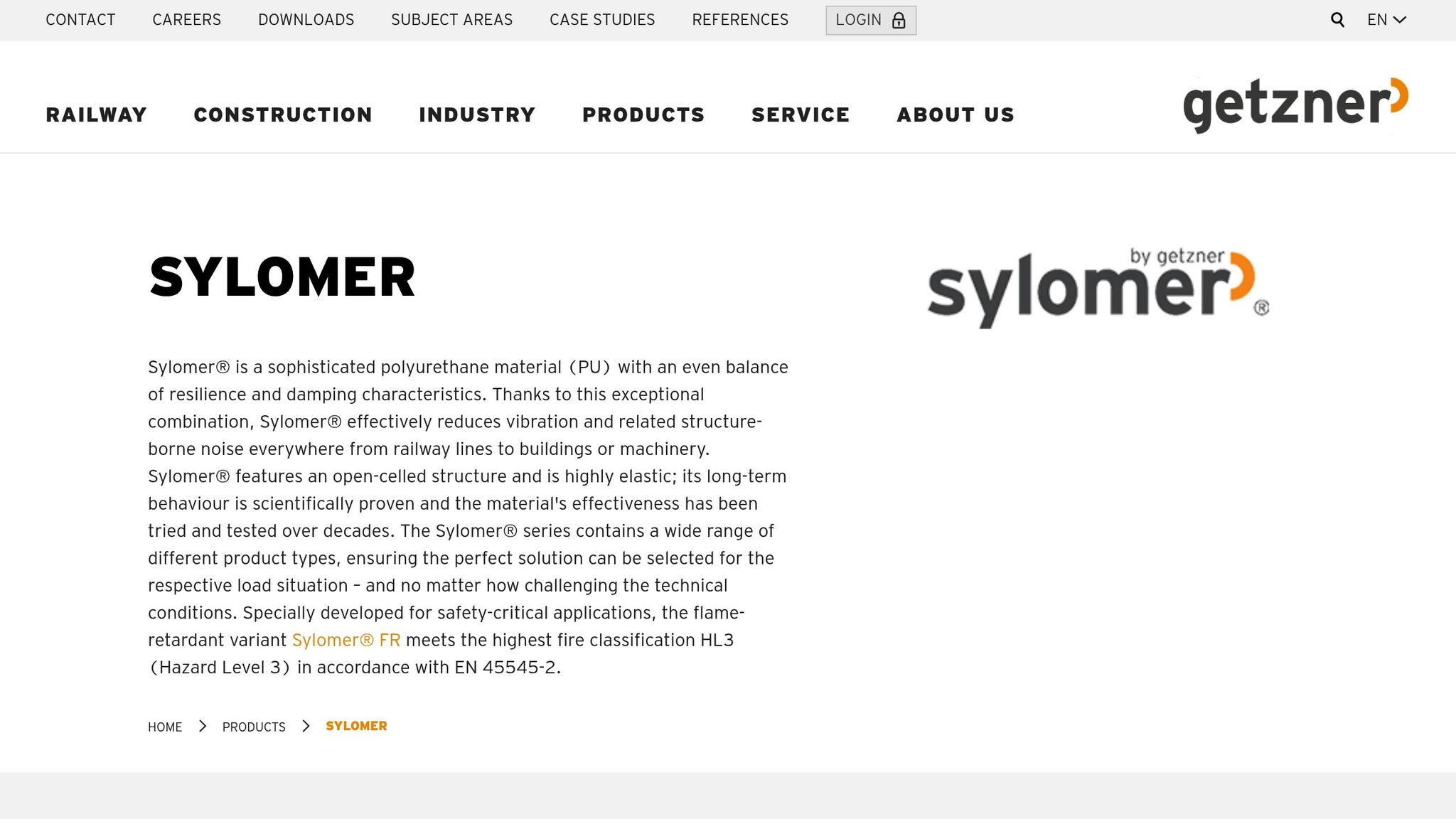
In this section, we will discuss Sylomer material, a solution that not only provides effective acoustic isolation, but also has fire safety properties.
Sylomer is a polyurethane elastomer that acts as an elastic insulating layer between structures. This material deforms under tension or compression, but returns to its original shape, effectively reducing structure-borne noise. Due to its porous structure, Sylomer combines spring and damping properties [6] . The fire-resistant version of Sylomer® FR contains special particles that ensure fire safety without losing its vibration damping efficiency [7] . These properties make the material suitable for even the most stringent safety requirements, for example for use in railway carriages.
Sylomer® FR is durable – it maintains its mechanical properties throughout its service life, even under difficult conditions [7] . Static loads can range from 0.028 N/mm² to 0.220 N/mm² , with short-term loads reaching up to 4.0 N/mm² [7] .
Sylomer acoustic properties
Sylomer® FR meets the HL3 classification according to EN 45545-2 , making it suitable for use in critical environments where fire safety is of paramount importance [7] [9] . One practical example is The Rushmore Building in Manhattan. In this 130-meter-high building, Sylomer was used to isolate vibrations caused by the AMTRAK railway line running underneath the building [9] .
The material effectively isolates structures, preventing noise from traveling through hard surfaces. This is especially important in raised floors, walls and ceilings, where it is necessary to reduce resonance, also known as the “drum effect” [1] . Sylomer® FR is also available in four different grades, allowing the material to be precisely tailored to specific load and frequency requirements [7] .
Applications of structural noise control
Sylomer® FR is often used in raised floors in passenger cars and railway infrastructure, where acoustic comfort and fire safety need to be combined. [7] [8] The material is integrated into acoustic hooks and floor systems to prevent mechanical energy from being converted into audible sound. [10] [11] In railway infrastructure, Sylomer is used as an elastic layer under ballast to protect it from breaking up due to dynamic loads, especially in bridges and tunnels. [8]
When selecting Sylomer® FR, it is important to ensure that the selected grade meets the intended static and impact load requirements [7] . If the material is to be used in humid environments, it is necessary to consider the compatibility of its pore structure with the requirements for moisture resistance [1] [7] . This solution is perfectly compatible with other insulation systems, ensuring not only sound insulation, but also fire safety.
sbb-itb-02aace5
Material efficiency comparison
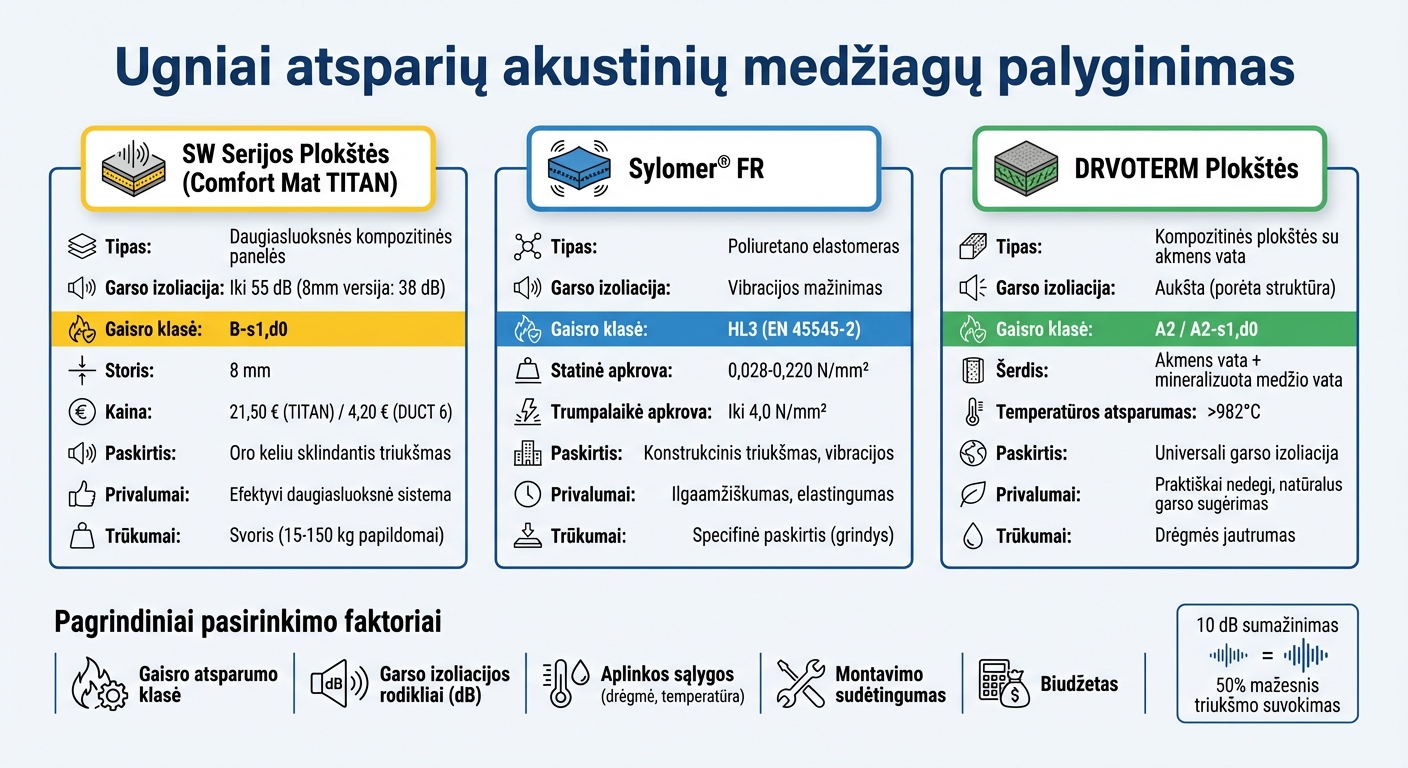
Comparison of fireproof acoustic materials: sound insulation and fire classes
When analyzing the previously discussed material properties, it is important to evaluate how these solutions work in practice and what their advantages are in different contexts.
Tecsound FT , SW panels and Sylomer
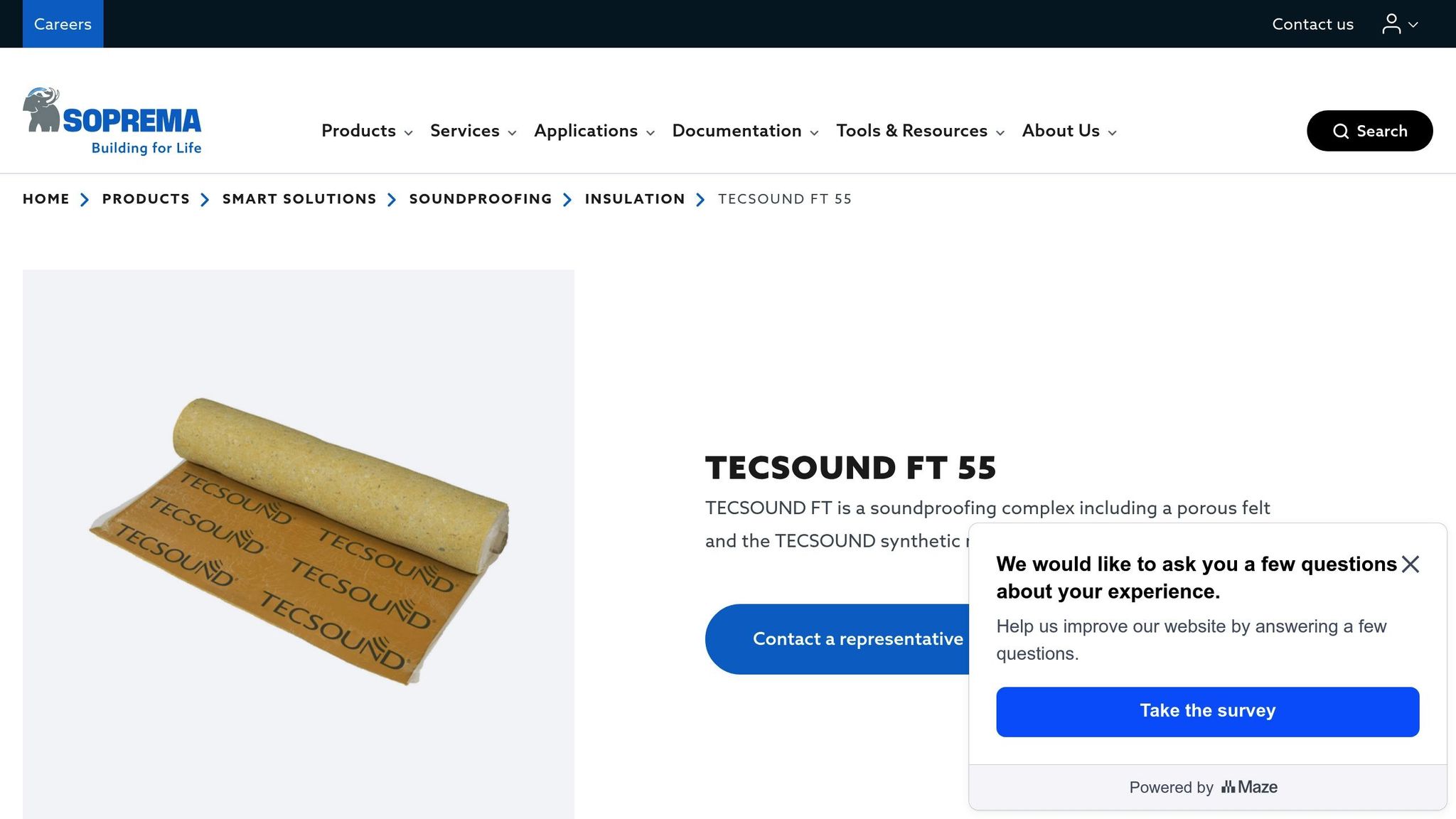
When choosing acoustic materials that also need to be fire-resistant, it is essential to understand their specific purpose. Tecsound FT is a viscoelastic membrane that effectively dampens sound and reduces vibration transmission, especially in ductwork or lateral structures [12] . SW series composite panels , such as Comfort Mat TITAN , are multi-layer systems that combine acoustic and high-mass layers, providing up to 38 dB of noise reduction [1] . Sylomer, meanwhile, is an elastic material specifically designed for structure-borne noise reduction.
Each of these materials has its own specific purpose: Tecsound FT is perfect for reducing noise in pipelines, SW panels effectively isolate airborne noise, and Sylomer – structure-borne noise in floors. In terms of price, Comfort Mat TITAN (8 mm) can be purchased for €21.50 , while lighter alternatives such as DUCT 6 (6 mm) cost from €4.20 [1] . These choices allow you to find the right solution according to your budget and needs.
Material compromises
While technical properties are important, each material has its own drawbacks and challenges. One key aspect is weight . The use of multi-layer insulation systems can increase the weight of a vehicle by 15 to 50 kg, and in more complex designs, even up to 150 kg [1] . This is particularly relevant in automotive soundproofing projects, where weight affects fuel consumption and chassis load.
Another important factor is resistance to environmental influences . Materials must withstand moisture and temperature fluctuations, as inferior products may harden, crack or lose flexibility. For example, bitumen vibration isolation materials are often supplemented with additives that ensure their elasticity even at lower temperatures [1] .
Cost and installation complexity are also important criteria. Mineral wool remains popular due to its affordability, but it often requires a high layer thickness to achieve good performance, and moisture can degrade its properties. [13] [14] Acoustic foam is a cheaper and lighter solution, but it may not be dense enough to effectively block low-frequency sounds. For this reason, additional additives are often added to provide fire resistance. [14] [15]
These trade-offs highlight the importance of carefully evaluating material selection to balance construction safety requirements with high acoustic quality.
Practical recommendations
Research summary
Fire-resistant acoustic materials not only provide effective sound insulation, but also contribute to safety. Multi-stage systems can reduce noise levels by up to 38 dB, and mineral wool retains its properties even at extremely high temperatures - more than 982°C [1] [16] . Materials that meet the requirements of Euroclass B-s1, d0 have limited flammability and lower smoke emission, making them particularly suitable for use in evacuation routes or public spaces [17] .
When choosing the right materials, it is necessary to take into account technical parameters and environmental conditions. For example, humidity can reduce the effectiveness of materials, so in places where there is condensation or direct exposure to water, it is recommended to use closed-pore materials [1] . These research results allow for reliable application of modern acoustic solutions in various situations.
AUTOGARSAS.LT acoustic solutions
AUTOGARSAS.LT offers professional solutions that combine high quality sound insulation and strict safety requirements. The company specializes in acoustic solutions for both cars and residential and business spaces, providing consultations, design services and professional installation, which is customized to the specifics of each project.
Products such as vibration damping materials and multi-layer acoustic membranes are offered for automotive soundproofing. For example, Comfort Mat TITAN or the lighter alternative DUCT 6 [1] . Meanwhile, solutions for homes and commercial premises include acoustic foams and special membranes for floor and wall insulation [1] . All products are selected according to strict fire-resistant standards.
Professional installation is essential to avoid mistakes such as improper layer alignment or ignoring the effects of moisture. Properly installed systems ensure a long-lasting and effective result [1] .
View all Soundproofing materials for walls
FAQs
How to choose the right fire resistance class (A2 or B-s1,d0)?
The appropriate fire resistance class always depends on the requirements of the specific project. For example, class A2 means that the material is practically non-combustible and does not ensure the spread of fire. Meanwhile, class B-s1,d0 allows a slightly higher flammability potential, but still meets the established safety standards.
To ensure that the selected material meets all local requirements, it is advisable to consult with specialists. They will help assess the specifics of the project and select the most appropriate solution.
What is the difference between airborne and structure-borne noise insulation?
Airborne noise insulation helps reduce sounds that travel through the air, such as through windows or doors. This is especially useful for reducing noise from outside, such as traffic or city noise.
Structural sound insulation , on the other hand, is designed to reduce sounds that are transmitted through the building's structures, such as walls or floors. This insulation is effective in reducing noise caused by neighbors' activities or vibrations within the building.
How does humidity affect the performance of acoustic materials?
Moisture can have a significant impact on the performance of acoustic materials, as it changes their physical properties. This can lead to a reduction in the ability to effectively absorb sound, poor sound insulation, and the material itself can deform. The effects on sound energy absorption and resonance control are particularly noticeable - in humid conditions, these properties can be significantly weakened, which negatively affects the functionality of the materials.


