

Speaker cables are an important part of your audio system . Choosing the wrong cable can reduce sound quality, so it's important to consider a few key factors:
- Cable thickness (cross-section): Thinner cables (e.g. 1.5 mm²) are suitable for short distances and low-power systems, while thicker ones (e.g. 2.5-4 mm²) are suitable for longer distances or more powerful systems.
- Material: It is best to choose oxygen-free copper (OFC), which ensures lower resistance and durability.
- Distance: For cables longer than 10 m, it is important to choose a thicker wire to reduce power loss.
- Speaker impedance: Lower impedance speakers (e.g. 4 Ω) require better cables because they are more sensitive to impedance.
Myths: Expensive "audiophile" cables often don't make a noticeable difference if you have the right cable thickness and quality copper. Also, gold-plated connectors are more about durability than improving sound quality.
Recommendations:
- 1.5 mm² - up to 50 W and up to 5 m.
- 2.5 mm² - 50-150 W and up to 10 m.
- 4 mm² – over 150 W or over 10 m.
If in doubt, it is better to choose a thicker cable, especially for longer distances or more powerful systems. AUTOGARSAS.LT offers a wide selection of cables, tailored to various needs and budgets.
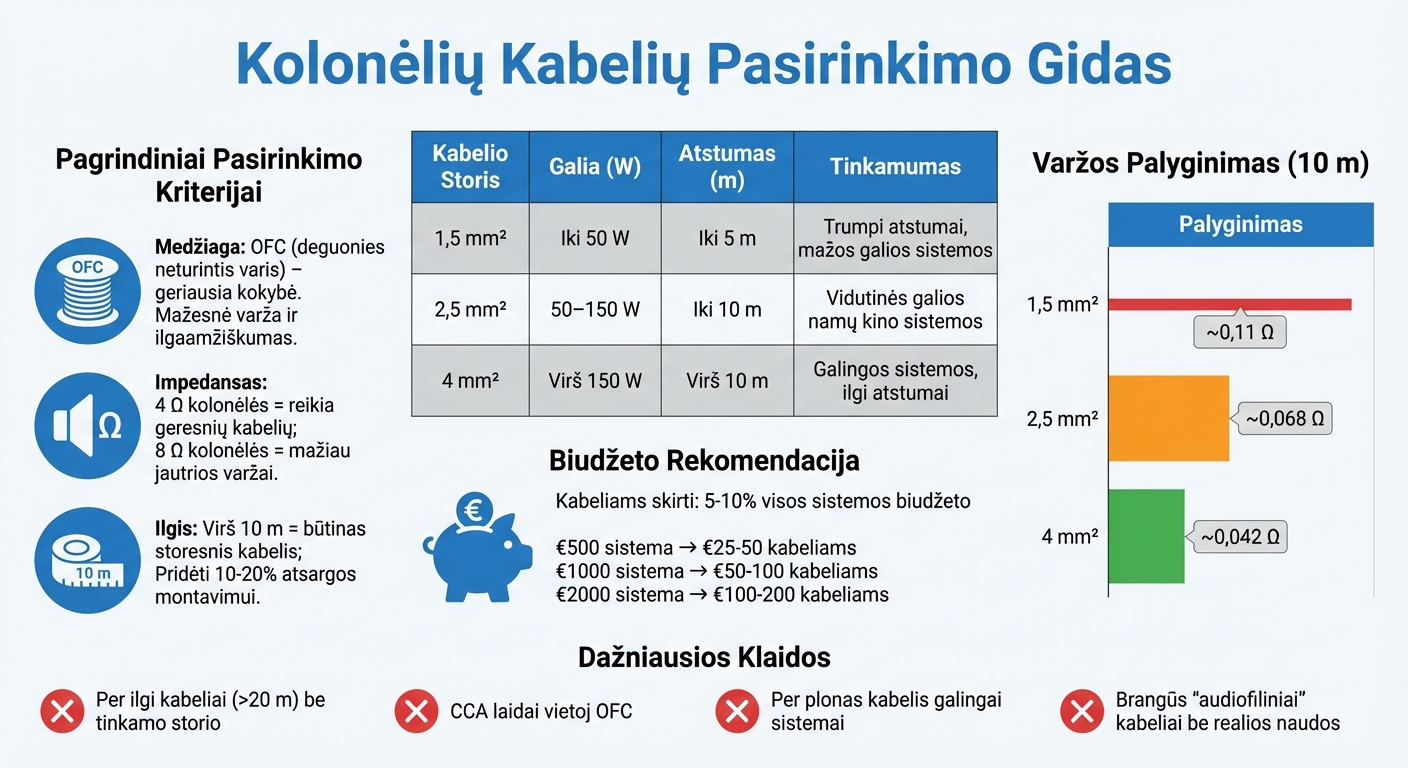
Speaker cable selection guide by power and distance
Technical specifications of speaker cables
Conductor material and purity
Speaker cables are usually made of copper , which provides a good value for money. Standard copper can contain up to 0.4% oxygen impurities, but oxygen-free copper (OFC) has less than 0.001% oxygen. This reduces the risk of oxidation and allows for more reliable signal transmission, especially at high frequencies, making OFC cables ideal for hi-fi systems.
Some cables are made with anodized copper , which increases conductivity by 5-10%. This is especially useful for getting clearer and more detailed high frequencies. Although such cables are more expensive, they offer a noticeable advantage in professional systems or critical listening environments. For example, Audioholics testing showed that OFC cables lose 0.5 dB less signal at 10 kHz over a distance of 10 meters than standard copper.
In Lithuania, OFC cables with a purity of 99.99% (4N) or 99.9999% (6N) are most often sold. Although higher purity reduces the resistance by 1–2%, the real effect is felt only in longer cables (over 10 meters). For home cinema systems or regular hi-fi equipment, a standard OFC cable is usually sufficient. The variety of cables offered by AUTOGARSAS.LT makes it easy to find the most suitable option.
Cable thickness and cross-section
The thickness and cross-section of the cable have a direct impact on the sound quality. A thicker cable reduces the impedance, which allows the amplifier to better control the speaker diffuser. The result is stronger and clearer bass frequencies.
Recommendations by power system and distance:
- 1.5 mm² – for systems up to 50 W and distances up to 5 meters
- 2.5 mm² - suitable for 50-150 W systems and distances up to 10 meters
- 4 mm² – ideal choice for systems above 150 W or when the distance exceeds 10 meters
For example, if a 100 W amplifier with 8 Ω speakers is connected 10 meters away, a 2.5 mm² cable maintains a damping factor of over 50, while a 1.5 mm² cable reduces it to less than 30. The cable impedance is calculated using the formula: impedance ≈ 0.017 × length (m) / area (mm²) . Thus, a 10-meter-long 1.5 mm² cable has a impedance of around 0.11 Ω, while a 4 mm² cable has only 0.042 Ω. Dynaudio tests have shown that this can improve bass response by 20-30%.
Cable construction and insulation types
Cable construction and insulation type are also important for both installation and signal quality.
Cables can be:
- Stranded – flexible and easy to install.
- Solid- core – lower impedance and suitable for stationary systems where signal integrity is important.
Insulation materials also play a role. PVC (polyvinyl chloride) is cheap and flexible, but can harden in winter. PE (polyethylene) has lower dielectric losses and transmits high frequencies better. Teflon, although expensive, has the lowest capacitance (about 50 pF/m compared to 200 pF/m for PVC), so it provides better protection against high frequencies. XLPE (cross-linked polyethylene) is best for outdoor or terrace systems, as it is frost-resistant and does not crack.
In urban apartments, where there may be a lot of electromagnetic interference, it is worth choosing cables with twisted pairs (twisted pair) or star-quad construction. Such cables reduce interference by 6-10 dB and maintain a high signal-to-noise ratio. Belden studies have shown that twisted pair reduces crosstalk noise by 20 dB at a frequency of 1 kHz.
AUTOGARSAS.LT offers carefully selected cables that ensure the best sound quality for your system.
How to choose speaker cables for your system
Cable matching with speakers and amplifier
When choosing speaker cables, it is important to consider the speaker impedance, amplifier power, and room size. These factors determine the thickness of the cable that will ensure quality signal transmission without loss.
For example, if you are using 8Ω speakers with a 100W amplifier in a 20m² room, a 2.5mm² (equivalent to 14-16 AWG) cable will be adequate for distances up to 10m. However, if you have 4Ω speakers or a system with a power output exceeding 200W, you will need a thicker 4mm² (12 AWG) cable as these systems draw more current.
Practical advice: measure the distance from the amplifier to the speakers, add 10-20% to the margin and choose the cable according to the power and distance. For small rooms (up to 15 m²), a cable of 5-10 m is usually sufficient, and for larger rooms - up to 20 m. If your amplifier has a power of more than 150 W, choose a thicker cable to reduce voltage drop.
Next, we will discuss how different sound systems require certain cabling solutions.
Cables for different audio systems
For home stereo systems (2.0 setup, 50-100W, small rooms), 2.5 mm² (14-16 AWG) OFC cables with lengths of 3-10 m are recommended. For example, In-Akustik Premium series cables with banana plugs ensure convenient installation. Avoid cables with a cross-section of less than 1.5 mm², as they can reduce bass clarity.
For home theater systems (5.1 or 7.1, 100-300 W), 4 mm² (12-14 AWG) cables are best suited. This is especially true for rear speakers, where distances can be up to 20 m. Goobay 12 AWG series cables are an excellent choice, as they maintain dynamic range even over longer distances.
For professional systems (PA equipment, over 500 W) 6–10 mm² (10-8 AWG) cables with a shielding layer that reduces electromagnetic interference are required. The In-Akustik Pro series offered by AUTOGARSAS.LT ensures low capacitance (up to 50 pF/m) and high resistance, making it perfect for concert halls or studios.
Choosing speaker cables AUTOGARSAS.LT
AUTOGARSAS.LT offers a wide range of cables to suit different needs and budgets. For example, In-Akustik Reference 12 AWG (3 meter pair: €49.99) is an ideal choice for high-end home stereo systems with 8Ω speakers up to 100 W. This cable has a very low impedance – less than 0.01 Ω.
For entry-level or budget systems, we recommend the Goobay Classic 16 AWG (5 meters: €19.99), which is perfect for mid-range home theater systems. If you are using bi-amping or bi-wiring, you should consider the In-Akustik Premium Bi-Wire 14 AWG (10 meters: €89.99). This cable allows you to connect the high and low frequency sections separately, which improves the sound detail in complex systems.
When choosing cables, follow a simple rule: the Goobay series is for practical solutions and beginners, and In-Akustik is for those who seek maximum sound accuracy. All prices are given in Lithuanian format with a comma for decimals (e.g. €49.99).
How to choose a speaker cable - guide Top Hi-Fi for beginners
sbb-itb-02aace5
Installation and connection recommendations
This section discusses practical tips for properly installing and connecting cable systems to ensure smooth operation and quality sound.
Cable routing planning
Before you start cutting cables, first measure the distance from the amplifier to the speakers accurately, taking into account the planned route. This means that you need to estimate the path along walls, around doors or furniture, and not in a straight line. For example, in a Vilnius apartment, a 4-meter straight distance can turn into 6 meters due to turns and detours. To ensure that the cable is conveniently laid and easily connected, add a 10-20% length margin.
It is important to keep speaker cables at least 10-20 cm away from 230 V power cables, especially if they run parallel. If the cables must cross, do so at a 90° angle to avoid interference. Also, avoid close contact with extension cords, TV power adapters or LED dimmers - these can cause noise. At typical distances of 2-10 meters, a well-laid unshielded cable usually does not experience audible interference. If you live in a rented apartment, you can secure the cables to the skirting boards using cable channels or adhesive holders. If you are planning a permanent installation, it is worth installing separate corrugated pipes in the walls, avoiding their alignment with the power installation.
Next, we will discuss which connectors to choose.
Cable connectors
Bare wires are a simple and economical solution, but they tend to oxidize. Banana-type connectors (4 mm) allow for quick connection and disconnection of cables, making them a great choice for AV receivers and Hi-Fi amplifiers, especially if speakers are frequently moved. Spade connectors provide a solid contact after the union nut and are suitable for high-end systems or situations where banana sockets are not available. Pin connectors are thin contacts for spring-loaded terminals, commonly used in older mini systems.
AUTOGARSAS.LT recommends banana plugs for home theater systems that need to be moved frequently, and plugs for stable stereo stands with thick cables.
Below are detailed connection instructions.
Connection instructions
Before starting work, turn off the amplifier and unplug it from the 230 V electrical outlet. Strip the insulation of the cables by 8-12 mm using a special tool or a sharp knife, being careful not to damage the copper strands. Twist the strands so that they are tight and neat. If you are using banana or fork connectors, make sure that the cable strands are fully inserted and tighten the screws evenly. Check that none of the copper ends of the wires touch adjacent terminals and that there is no short circuit between "+" and "–".
Observe polarity rules : use color-coded connectors (e.g. red/black) and connect the marked side to the red terminals. Improper polarity can cause sound quality problems, such as reduced bass or a blurred stereo image. After turning on the amplifier, start at a low volume level, play test material, and gradually increase the volume, observing that the system operates without interference.
"If anyone is setting up a new house, I recommend consulting with the "Autogaras" team! They sincerely advised how and what wires to run, where and what speakers to place or connect. They put everything together on the project, and later installed the equipment. A true team of professionals!!!" – Daiva, Customer Review on Rekvizitai.vz.lt [1]
Cable length, budget and future system changes
Cable length calculation
To avoid future system upgrades, it is important to plan your cable lengths properly. First, measure the exact distances from your amplifier to each speaker. Don’t forget to add 10-20% extra length so that the cables can be conveniently hidden behind skirting boards or cable ducts. For example, if your room is 20 m² (5 m × 4 m), you will need about 4 m of cable for the rear speaker, and about 5 m in total with a margin.
Long cables can increase resistance, so it is important to choose the right thickness. If the cable length does not exceed 15-20 m, use 1.5 mm² (16 AWG). For longer routes, choose 2.5-4.0 mm² (14-12 AWG) to avoid signal loss. If you plan to run cables through several rooms, it is better to choose a thicker cable right away - this will ensure stable operation and reduce problems in the future.
Balance of performance and price
It is recommended to allocate 5-10% of the total system budget for cables. For example, if your system costs €500-1,000, you should spend about €25-100 on cables, and if the system costs more than €2,000 - 10-15% of the budget. The most important thing is the purity and proper thickness of the conductor, not the brand. For example, a 10 m long 2.5 mm² OFC cable from AUTOGARSAS.LT costs about €25-30 and is perfect for mid-range systems.
While some "audiophile" cables cost €10/m or more, a simple 2.5 mm² OFC cable for €2/m often delivers better performance due to lower impedance. Experts say that for cables costing more than €5/m , most users no longer notice a significant improvement in quality. Therefore, it is better to invest in the right cross-section than in expensive, exotic materials.
When planning your system, don't forget to consider possible future upgrades - this will help you avoid additional costs.
Planning for system updates
If you plan to expand your system in the future, for example from stereo to 5.1 or multiroom audio, consider using thicker cables, such as 2.5-4.0 mm² , right away. Such cables will allow you to connect more powerful amplifiers without having to change the wiring. When renovating, it is worth installing corrugated pipes in the walls to make it easier to add or replace cables in the future. This will not only save time, but also reduce costs.
Banana plugs can also be useful, as they make it easier to move the speakers. It is also recommended to leave 20-50% extra cable length to allow for more flexibility when changing the layout of the room. If you are unsure how to properly plan your cabling system, AUTOGARSAS.LT specialists can help you customize solutions to your needs - this is especially important in newly built homes or more complex multi-channel systems.
Properly selected cables and well-thought-out planning will ensure long-term sound quality and avoid unnecessary worries in the future.
Conclusion
Speaker cables are an essential link that ensures stable signal transmission and high-quality sound. Properly selected cables help reduce impedance, improve sound clarity and allow you to maximize the capabilities of your sound system. When choosing cables, the most important things to pay attention to are the conductor material (the best choice is OFC copper), the thickness of the wires (1.5–2.5 mm² is usually sufficient for home systems) and the cable length (it is recommended not to exceed 15 m). Experts indicate that high-quality cables can reduce sound distortion to 0.1%.
In addition, the right cables not only improve sound quality, but are also a cost-effective choice. It is recommended to allocate about 5-10% of your total audio system budget to cables. For example, if your system costs €1,000, €50-100 on cables will be enough to achieve excellent performance without overspending. Avoid common mistakes: cables that are too long (more than 20 m) can increase resistance by 15-30%, and cheap CCA cables significantly degrade sound quality compared to pure copper cables.
AUTOGARSAS.LT offers a wide range of speaker cables, tailored to various needs and budgets - from economical solutions, such as SA-0.50T cables for 0.22 €/m, to top-class OFC cables with SPK connectors, such as 2x2.5 mm² cable (15 m) for 52.00 €. Our specialists are ready to help you choose the most suitable option that meets your needs - whether it is a home cinema system ,Hi-Fi stereo equipment or a multiroom audio solution .
To take advantage of these tips, visit autogarsas.lt, where you will find a wide selection of cables and you can consult with our specialists. We also invite you to visit our store in Kaunas (Armatūrinininkų g. 1) or contact us by phone +370 683 90000. With more than 27 years of experience in the field of audio systems, we will help you optimize your equipment and ensure impeccable sound quality.
FAQs
How to choose the right thickness cable for a home theater system?
When choosing a cable for a home theater system, it is recommended that its thickness be between 1.5 mm and 2.5 mm . This depends on the size of the room and the technical characteristics of the speakers. Thicker cables are beneficial because they transmit the audio signal better and reduce losses, especially if the distances between the equipment are large.
It is also important to ensure that the cable is of good quality and has the right connectors. This will help to achieve a clean, natural sound. When in doubt, it is always worth choosing a thicker cable - it will be especially useful in larger rooms or when using powerful speakers.
Do OFC copper cables really improve sound quality?
Yes, OFC (oxygen-free copper) cables can really improve sound quality. They offer excellent electrical conductivity and minimal signal loss, making the sound clearer and the details sharper.
Due to their lower resistance, these cables are especially suitable for longer runs or high-quality audio systems where even the smallest details are important. When choosing cables, it is worth paying attention to their thickness, length and connectors to ensure that they best suit the needs of your audio system.
How to accurately measure and choose the right length of speaker cable?
To determine the correct length for your speaker cable, first measure the distance between your sound source and your speakers. You can use a tape measure or other flexible measuring tool to do this. It is recommended to add an extra 10-15% to the resulting length to make it easier to connect the cable and avoid strain.
It is also important to choose a cable that fits your sound system layout and gives you enough freedom. This is especially important if you plan to move your speakers in the future. Choosing the right cable length will not only make it easier to use, but also ensure that your sound system runs smoothly.


