

The placement of speakers in a room has a big impact on sound quality. Even the most expensive system will sound bad if it is placed incorrectly. Key tips:
- Symmetry is important : the speakers should be equidistant from the walls and the listener.
- Distance from walls : It is recommended to place the speakers at least 20-50 cm from walls to avoid bass amplification.
- Listening position : form an equilateral triangle between the speakers and the listener.
- Soft surfaces : Carpets, curtains, and upholstered furniture help reduce echo and improve sound balance.
- Subwoofer : It is best to place it in the corner of the room.
For best results, experiment with speaker placement and use auto-calibration features if your equipment has them. If you have any difficulties, consult a professional who can help you adjust the system to your space.
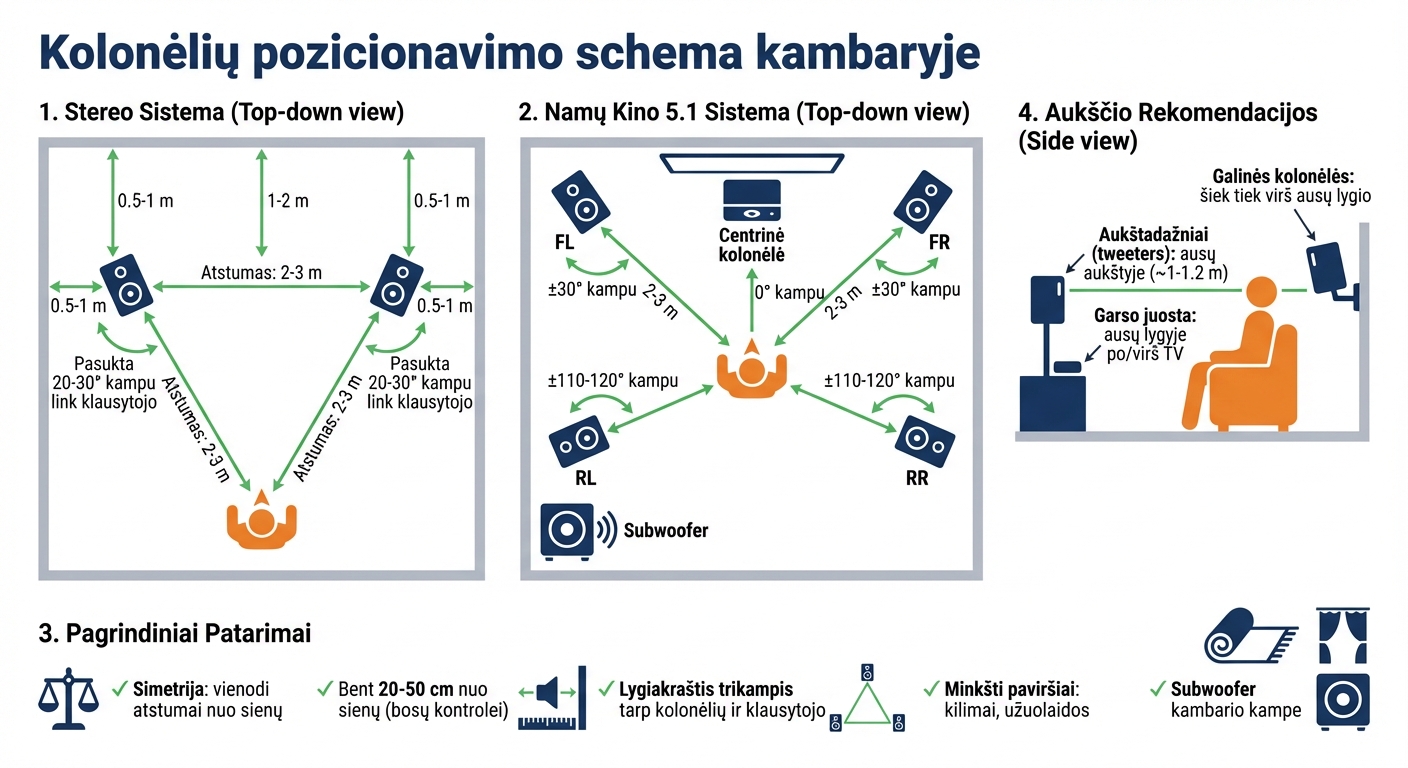
Speaker positioning diagram: optimal distances and angles
SELECTING AND INSTALLATION OF A SOUND SYSTEM FOR YOUR HOME
How room acoustics and listening position affect sound
The sound produced by speakers consists of two main components: direct sound and reflected sound. Direct sound is responsible for clarity – it conveys vocals and instruments as they should sound. Reflected sound, on the other hand, creates a sense of space and adds reverberation. However, if there are too many reflections, echoes and distortions can occur.
In Lithuanian homes, especially in old-built apartment buildings or new apartments with open spaces, we often encounter hard floors, large windows and few soft surfaces . In such rooms, sound often sounds harsh or echoey due to strong reflections. As Darius Vedegys , head of Audiokomponentai , notes, soft surfaces such as thick curtains, carpets or upholstered furniture help reduce reflections and create a better balance between direct and reflected sound [2] .
The listening position is also very important. The "sweet spot" is the optimal location where the direct sound is dominant, allowing for accurate stereo reproduction. This location is usually formed by the principle of an equilateral triangle : the left and right speakers are 2-3 meters apart, and the listener sits the same distance in the center [2] [4] . If you sit off-center, you may experience phase problems or uneven frequency response, which can make the sound less impressive.
To properly balance direct and reflected sound, it is necessary to take into account the characteristics of the room. We will discuss below how the size and shape of the room affect sound quality.
Room size and shape
The size and shape of the room greatly affects how sound travels and where problem areas may occur. In small rooms (up to 15 m²), speakers can be placed closer to the walls, about 0.5–1 meter away. However, it is important to use sound-absorbing materials such as carpets or curtains to reduce bass buildup in the corners. [2] [3] In medium-sized and larger rooms, speakers should be at least 1–2 meters away from the walls to avoid reflections and standing waves. [2] [3] [4]
Rectangular rooms allow for more even sound distribution, especially if the speakers are placed symmetrically, for example 0.5–1 meter from the side walls. However, parallel walls can cause standing waves that strongly affect the low frequencies. Irregularly shaped rooms , such as L-shaped living rooms, are better at scattering reflections, but their asymmetry makes it difficult to determine the optimal listening position. In this case, careful selection of speaker and listener positions is necessary [2] [3] .
In addition to the characteristics of the room, it is important to properly place the speakers and choose the listening position.
Listener position and speaker symmetry
Symmetrical speaker placement is essential so that the sound reaches both ears in the same way. This ensures an accurate stereo effect and tonal balance. If one speaker is closer to the wall than the other or the listener is not sitting in the center, the sound becomes uneven - one side sounds louder, and instruments lose clarity. The ideal solution is an equilateral triangle : the speakers are spaced 2-3 meters apart, the listener sits at the same distance in the center, and the speakers are turned towards him at an angle of about 30° [2] [6] .
The position of the listener also has a big impact. If you sit too close to the speakers (closer than 1.5 meters), the sound can be too intense and uneven. If you are seated against a rear wall, reflections from the wall can amplify certain frequencies, making the sound "cloudy". In home theater systems , the listener should sit perpendicular to the screen, with the rear speakers slightly behind them, facing towards the listening position [2] [5] . By following these principles, you can create a clearer, more balanced and impressive sound.
Speaker positioning by type
In this section, we will discuss how to properly position different types of speakers to match their technical characteristics with the acoustics. Different sound systems have specific requirements to achieve the best sound quality.
Stereo speakers (shelf and floor-standing)
In stereo systems, it is important to form an equilateral triangle: the speakers should be placed 2–3 m apart , with the listener in the center of the triangle. Recommended distances from walls: 0.5–1 m from side walls and 1–2 m from the rear wall [2] [3] .
To achieve an accurate stereo effect, it is recommended to angle the speakers 20-30° towards the listener. This will ensure that the high frequencies reach the ears directly. If the speakers are pointed straight ahead, the sound becomes wider, but less focused. If the speakers are angled too far, the sweet spot area will be narrowed.
Home theater speakers (center, rear and Dolby Atmos )

The center speaker , responsible for dialogue, should be placed directly below or above the television , at the height of the listener's ears. [2] [5] [7] The front side speakers should be positioned at an angle of ±30° from the listener and 2–3 m away , and their height should be matched to the center speaker. [2] [7]
It is recommended that the rear speakers in a 5.1 system be positioned at an angle of ±110–120° behind the listener, slightly above ear level. [2] [7] In a 7.1 system, the rear speakers are moved even further, at an angle of ±135–150° . [2] [7] For Dolby Atmos speakers, such as the SVS Ultra Elevation , ceiling mounting or upward-firing modules that create an elevation angle of 30–55° above the listener are suitable. [2] [8]
Soundbars and compact systems
The soundbar is best placed at ear level (about 1–1.2 m from the floor ) directly below or above the TV [2] [9] . Leave at least 10–20 cm of space from the wall to avoid excessive bass buildup [2] [9] . It is recommended to place the subwoofer in a corner of the room to distribute the bass more evenly [2] [9] . If using wireless rear speakers, it is best to place them behind the listener's ear level.
Subwoofer positioning and bass control
Subwoofers emit sound in all directions , so you can place them pretty freely [2] . However, it is best to place them in the corner of the room - this way the walls enhance the bass effect and ensure a more even distribution [2] [3] .
Every room is unique, so it’s worth trying the “subwoofer crawl” method . This means moving around the room until you find a spot where the bass sounds balanced. [2] [3] This method helps to avoid standing waves and frequency peaks, ensuring better sound quality.
sbb-itb-02aace5
Working with room acoustics and furniture
Room acoustics are an integral part of the sound system, as the room becomes an important component of the sound [4] . Even the best equipment will not be able to sound well if the room is dominated by hard surfaces that reflect sound and create echoes. Lithuanian acoustics specialists emphasize that improper placement of speakers and furniture often has a greater impact on poor sound than the equipment itself [2] [4] . Let's look at how the use of furniture and soft materials can help improve acoustics.
Use of furniture and soft materials
Soft, porous surfaces, such as carpets, curtains, or fabric-covered furniture, reduce sound reflections and help maintain better balance. Meanwhile, hard, smooth surfaces, such as bare walls, windows, or laminate floors, reflect sound, causing harsh reverberations [2] .
Carpet placed between the speakers and the listener can reduce floor reflections and soften high frequencies. [2] Heavy curtains covering large windows are particularly effective in reducing reverberation and harshness, especially if they cover the entire wall area, not just the glass. [2] Upholstered furniture such as fabric-covered sofas, armchairs, or ottomans absorb mid- and high frequencies. They are particularly useful on side walls, near the first reflection points of the speakers, where they help reduce early side reflections and improve the clarity of the stereo soundstage. [4]
Bookshelves , with their books and decor arranged unevenly, act as diffusers, breaking up mid- and high-frequency reflections, reducing the "box" effect and giving the soundstage more depth [4] . The best place for such shelves is behind the listener or on the side walls next to and behind the speakers. Asymmetrical shelving segments further increase diffusion, especially in rectangular rooms, where a "greenhouse" sound can occur [4] .
Solving asymmetry and space constraints
In open-plan spaces, such as a living room that connects to a kitchen, it is recommended to orient the listening area towards the more enclosed part of the room . This will ensure a more symmetrical distance between the speakers and the sofa to the walls or furniture [2] . If one side of the room is open and the other is close to a wall, the acoustic difference can be compensated for by thicker curtains or bookshelves on the close side, and by placing a tall piece of furniture, such as a shelf or cupboard, on the open side [2] [4] .
When speakers are forced close to corners, it is recommended to move them at least 20-50 cm away from the walls. This will help reduce bass amplification and avoid frequency peaks [4] . In rooms with niches or protrusions, it is worth experimenting with the location of the speakers, avoiding placing them directly in the niche, as this can amplify certain frequencies [4] . If the sofa is close to the wall, the sound can be “pushed back” by using cushions behind the head level or by slightly raising the speakers so that the sound comes from a higher position [4] .
System tuning and calibration
Once the speakers are in place and the room acoustics are aligned with the furniture arrangement, the final, but crucial, step is to fine-tune the sound . Even perfectly placed speakers can sound even better if you adjust their angles and settings properly. This process involves manually adjusting the position and angle, as well as using an automatic calibration system (if your amplifier has one). We’ll discuss both methods below to achieve the best possible sound balance.
Manual tuning methods
Successful tuning starts with a symmetrical speaker placement. However, it’s also worth experimenting with small changes in position. Start with small movements – move the speakers 5–10 cm forward, back or to the sides. Each time, listen to familiar music where the vocals are clearly audible. Turn the speakers inwards by about 10–20° and see if the sound becomes clearer [2] [10] . If the vocals and instruments sound balanced, the angle is correct. If not, continue to adjust their position.
Lithuanian sound specialist Darius Vedegys emphasizes: symmetry is essential . Both speakers should be at equal distances from the listener and the side walls, otherwise the soundstage may shift to one side [2] .
It is also useful to do the so-called clap test . Stand in your listening position, clap your hands and listen for the echo. If the echo is stronger on one side, add soft materials such as pillows or curtains, or move the speaker further away from the wall. Also, don’t forget about height – tweeters should be at about ear height so that the sound reaches you directly, rather than through reflections from the floor or ceiling [2] .
If manual tuning does not meet expectations, switch to automatic calibration.
Automatic calibration systems
If your amplifier has an automatic calibration feature, this can be a great help. Popular systems such as Audyssey (Denon/Marantz), Dirac Live , Yamaha YPAO or Pioneer MCACC are quite simple to use. Connect a calibration microphone, place it on a tripod at ear height in your main listening position and let the system do its work. The amplifier will play test tones through each speaker, and the system will measure distances (±3 cm), sound levels (±0.5 dB) and frequency response. It will then automatically adjust the EQ, delay and crossover for the subwoofers [2] .
For example, Audyssey MultEQ XT32 can analyze up to 8 different points and adjust frequencies up to 20 kHz - which is perfect for small Lithuanian living rooms. However, it is important to understand that automatic calibration has its limits . It cannot correct poor speaker placement. Therefore, always first manually determine the optimal location (for example, form a triangle and keep the speakers at least 20 cm from the walls), and only then run the calibration [2] [10] .
Some automatic calibration systems tend to reduce the subwoofer level. After calibration, check this setting and, if necessary, manually increase the subwoofer level by 3-6 dB to suit your personal needs.
"I bought a music sound system for my home at a car audio store, the employees consulted, selected the best option, installed and adjusted everything. I am extremely satisfied with the result. A big THANK YOU to the team! I recommend it :)" – Rita [1]
If you are not feeling confident or want a professional result, the AUTOGARSAS.LT team can come to your home. They will accurately measure the room, optimally place the speakers, and adjust all the settings so that your system sounds perfect in your space.
Conclusion
Summarizing the main tips of the guide, it is important to pay attention to several essential points that will help ensure clear and balanced sound. Place the speakers correctly, observing symmetry, maintain optimal distance from the walls and choose a suitable listening position. For a stereo system, it is recommended to form an equilateral triangle - the distance between the speakers should be 1.5-2.5 m, and the same distance should be from you. For a home theater system, it is important that the center speaker is directly in the middle of the screen, and the side speakers - at equal distances from it. Do not place the speakers close to the walls or corners (the exception is the subwoofer), as this can cause unwanted sound reflections. Choose a listening position directly in front of the screen, avoiding being too close to the back wall to avoid standing waves. Upholstered furniture, carpets and curtains will also help reduce echo and improve the acoustics of the room.
When living in apartment buildings, where partitions are often thin, it is worth considering the power of the system and the size of the room. A system that is too powerful will not reveal its capabilities in a small room, and the bass sound may disturb the neighbors. In this case, it is better to choose a quality soundbar, which will ensure good sound without additional hassle.
Once you have the basic speaker placement done, pay attention to the finer adjustments. Even a change of a few centimeters can make a noticeable difference in the sound balance. If your amplifier has an automatic calibration function, such as Audyssey, Dirac Live or YPAO, run it after manual tuning - this way the system will automatically adjust the frequencies and delays to suit your room.
If you still can't achieve the desired result, it's worth turning to professionals. The AUTOGARSAS.LT team, with over 27 years of experience, can take care of everything - from selecting the right equipment to placing and accurately calibrating the speakers in your home. Specialists will accurately measure your space and adjust the system so that it sounds perfect.
For more information or consultation, visit the AUTOGARSAS.LT showroom in Kaunas or contact us by phone or e-mail. Here you will find not only professional advice, but also high-quality audio equipment and solutions tailored to your needs.
FAQs
How to properly place speakers in a room to get the best sound quality?
The placement of speakers in a room plays a crucial role in achieving the highest sound quality. Properly set the distance between speakers, their position in the room, and their distance from walls can help reduce unwanted resonance and noise.
How to arrange the columns correctly?
- It is recommended to place the speakers so that they form an equilateral triangle with the listener's position. This helps ensure balanced sound.
- Maintain a distance of at least 20-50 cm from walls. This gap reduces sound reflections and helps prevent distortion.
- If the room is larger, try tilting the speakers slightly towards the listener. This may provide a clearer and more balanced sound.
Don't forget the room acoustics
Every room is unique – furniture placement, room size and acoustics can all affect the final result. Experiment with speaker placement to find the optimal solution that works best for your space.
What are the main mistakes when installing speakers in a room?
When people install sound systems, there are a few common mistakes that can significantly affect the sound quality:
- Incorrect distance between speakers – if speakers are placed too far apart or, conversely, too close together, the stereo sound can become unclear and lose its spatial effect.
- Placing speakers too close to walls can cause resonance, making the sound muddy and the bass too strong.
- Improper listening position – sitting too close or too far from the speakers can cause the sound to lose its balance, and important details can simply be "drowned".
To achieve optimal sound, it is important to consider the principles of acoustics and adapt the placement of speakers to the size and layout of the room. Properly adjusted positioning can completely change the listening experience.
How can furniture help improve room acoustics?
Furniture can have a significant impact on the acoustics of a room – it absorbs sound and reduces echoes, making the space more pleasant. To achieve this effect, choose soft furniture with textile upholstery, add rugs or thick curtains. These elements not only help reduce sound reflections, but also create a cozy atmosphere.
Bookshelves and other uneven surfaces act as sound diffusers, making them particularly useful for improving sound quality. And if you’re looking for even more effective solutions, consider installing special acoustic panels. Together with upholstered furniture, they can help create an optimal acoustic environment for your home or workspace.


